

par Aston Bay Holdings Ltd (NASDAQ:ATBHF)
Aston Bay Identifies 17 New Base and Precious Metal Showings at the Epworth Copper-Silver Project, Nunavut, Canada
Up to 29.2% Cu with 217 g/t Ag in vein mineralization spatially associated with MobileMT nomalies
TORONTO, ON / ACCESS Newswire / January 15, 2026 / Aston Bay Holdings Ltd. (TSXV:BAY)(OTCQB:ATBHF) ("Aston Bay" or the "Company") is pleased to announce results from the 2025 summer field program at its Epworth sediment-hosted copper ("Cu") - silver ("Ag") - zinc ("Zn") - cobalt ("Co") - gold ("Au") project ("Epworth" or the "Project") located 80 kilometres ("km") southeast of Kugluktuk in Nunavut, Canada.
Highlights
17 new base and precious metal showings discovered during the 2025 field program at the Epworth Copper-Silver Project, Nunavut
High-grade copper and silver returned, including up to 29.2% Cu with 217 g/t Ag in grab samples from chalcocite veins at the Greenback Showing
Copper-gold mineralization identified, with assays up to 5.42% Cu and 1.89 g/t Au and 3.73% Cu with 2.08 g/t Au in disseminated sediment-hosted styles of mineralization
Strong zinc-lead ("Pb") results, including up to 10.1% Zn and up to 17.8% Pb, plus elevated cobalt values up to 379 ppm Co
Mineralization spatially associated with MobileMT conductors, supporting a robust sediment-hosted copper system and potential for significant buried mineralization
Results further de-risk and refine targets for a planned 2026 drill program, testing both high-grade veins and large-scale stratiform Cu-Ag-Co mineralization
Prospecting and mapping identified 17 new base and/or precious metal showings spatially associated with Mobile Magnetotelluric ("Mobile MT") geophysical anomalies, including zones yielding up to 29.2% Cu with 217 grams per tonne ("g/t") Ag, 5.42% Cu with 1.89 g/t Au, 3.73% Cu with 2.08 g/t Au, as well as up to 10.1% Zn, 17.8% Pb and 766 ppm ("parts per million") Co from select grab samples.
"We are extremely pleased to discover multiple base and precious metal showings during the 2025 mapping and prospecting program in the southern portion of the property, an area that had seen little previous exploration," stated Thomas Ullrich, CEO of Aston Bay.
"These strongly mineralized zones indicate an efficient mineralizing system, and their location immediately above the large geophysical conductors defined by the MobileMT survey suggests a link to potentially more mineralization hidden in the subsurface. Critically, copper, zinc and gold mineralization have been discovered in the rarely outcropping Recluse Group rocks, the proposed source of the geophysical anomalies, supporting our theory that those conductors may represent a potentially significant amount of mineralization yet to be discovered in the subsurface.
"With the market trend toward record copper and silver prices, we are excited to integrate the new data into an anticipated 2026 drill program targeting potential large and high-grade stratigraphic (sediment-hosted-style) Cu-Ag-Co mineralization as well as high-grade Ag-Cu veins."
Bruce MacLachlan from Emerald Geological Services, vendor of the Epworth Property, added, "Emerald Geological Services believes that the discovery of these multiple new base and precious metal showings on the Epworth Project highlights the huge potential of this land package and its underexplored nature. Every field program brings us closer to unlocking that potential as we increase our understanding of the geology and mineralization."
2025 Field Program
Seven crew members from Emerald Geological Services spent four weeks working at two float-plane-supported campsites on the property. Field work focused on the southern half of the property, where the 2024 property-wide MobileMT geophysical survey identified both deep, lower-frequency conductors (up to 900 m below surface) and near-surface, higher-frequency conductive anomalies. This area was only sparsely prospected before the new geophysical data were received. The conductors are postulated to correspond to pyritic and graphitic layers in the shales of the Recluse Group, which may act as a trap for metal-bearing fluids (see Aston Bay's June 5, 2025, news release for more discussion). Exploration also focused on the dolomites of the Lower Rocknest Formation and the clastic sedimentary rocks of the Upper Odjick Formation, which are known to host sediment-hosted copper mineralization such as that found in the Central African Copper Belt.
The showings, sampled from outcropping, subcropping (broken but deemed in place) rock and local boulders, are described in Table 1 and categorized by the styles of mineralization present. Of 309 select grab samples, 22 yielded ≥1% Cu, 22 samples yielded > 5 g/t Ag, 16 samples yielded >1% Zn, and 7 samples yielded >0.5 g/t Au. See Figure 1 for location and select grab sample results for each showing. Follow this link for copper, zinc, silver, gold, cobalt and lead results mapped thematically.
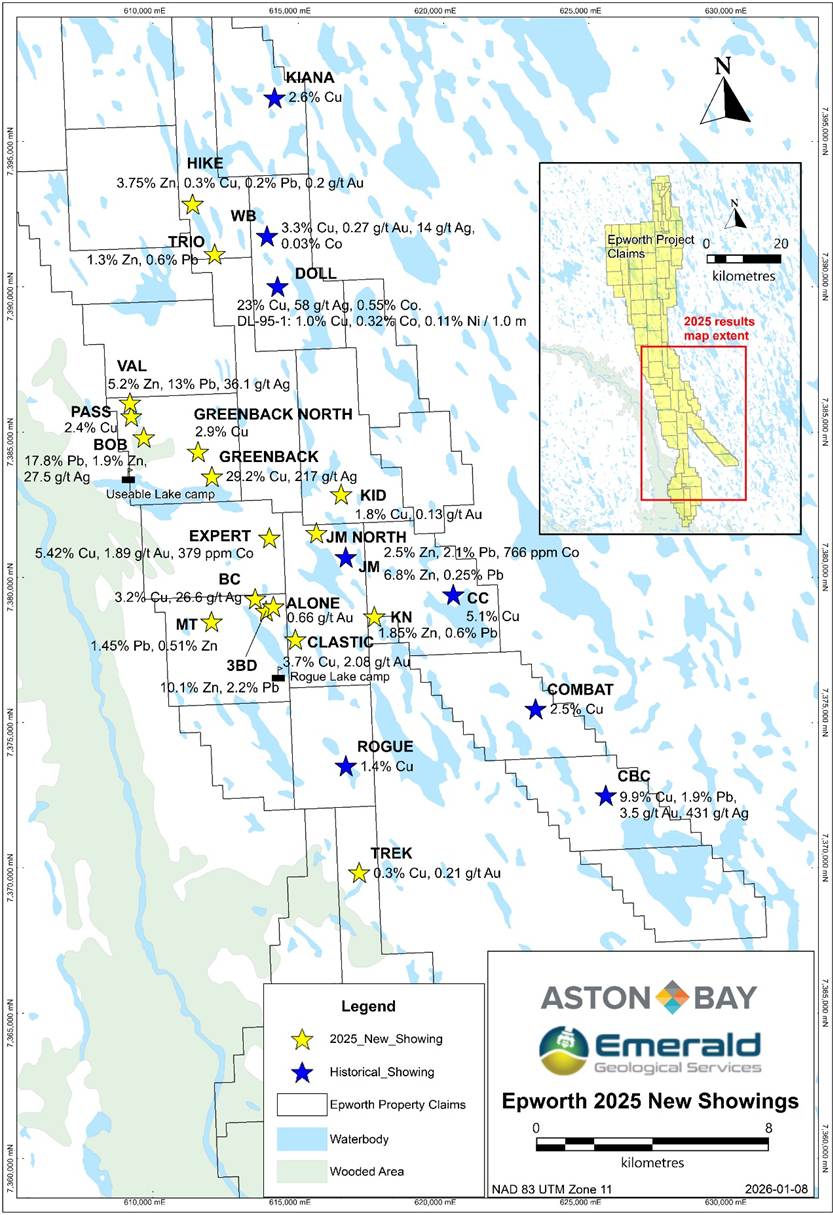
Figure 1: New (yellow star) and historic (blue star) showings from the 2025 mapping and prospecting program in the southern portion of the Epworth Project, Nunavut, with select assay results.
Discussion of Results
Of the styles of mineralization encountered in the 2025 field program, the highest copper and silver values were returned from vein-hosted copper mineralization in Lower Rocknest dolomite, present at the Greenback, Greenback North, BC, Kid and Expert Showings, with Greenback returning 29.2% Cu with 217 g/t Ag in chalcocite veinlets (Figures 1 and 2). The Greenback Showing is similar in character to the Payback Cu-Ag showings in the northern part of the property, which originally returned up to 61% Cu and 5600 g/t Ag (Payback South Showing, see March 1, 2024, Aston Bay news release). Both are spatially associated with diabase dikes and with MobileMT conductance anomalies.
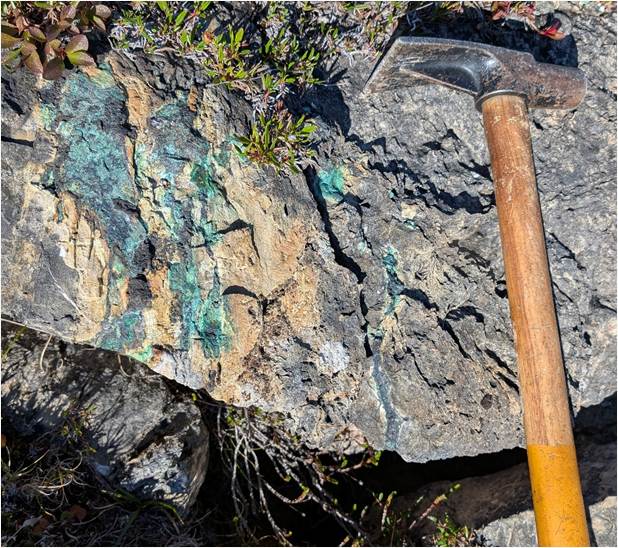
Figure 2: Chalcocite veinlets in dolomite at the Greenback Showing, yielding up to 29.2% Cu with 217 g/t Ag. Chalcocite is the dark grey metallic mineral that shows minor surficial weathering to green malachite.
Disseminated mineralization in Upper Odjick clastic rocks yielded significant copper and gold values at the Expert and Clastic Showings (Figure 1), with up to 5.42% Cu and 1.89 g/t Au at Expert (Figure 3) and up to 3.73% Cu and 2.08 g/t Au at Clastic (Figure 4). The Alone Showing falls along the same trend as Clastic (and likely along the same fault-offset trend as Expert and Greenback) and returned 0.66 g/t Au. These showings, especially Clastic, may be analogous to the historical WB Showing in the south-central part of the Property, which historically returned values up to 3.3% Cu, 0.27 g/t Au, and 0.03% Co in quartzite boulders. The WB Showing was subject to the focus of a minor 1995 drill program (1170 m) by Noranda, which did not locate the source of the mineralized boulders but intersected similar reduced coarse clastic sediments with disseminated pyrite +/- chalcopyrite over widths of up to 27 meters (Rees and Petrie 1996).
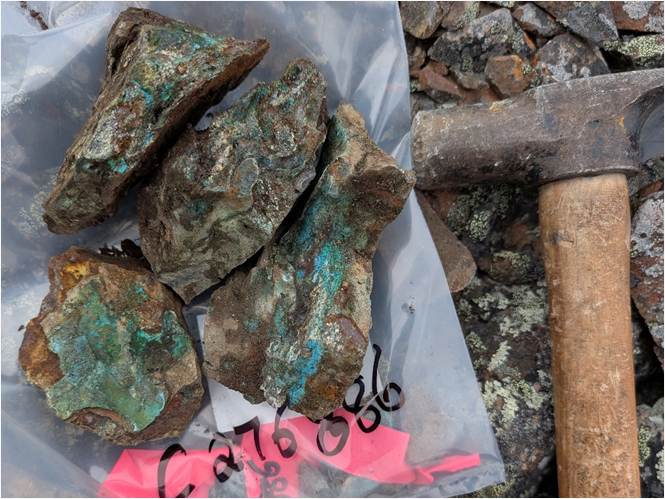
Figure 3: Disseminated chalcopyrite-bornite at the Expert Showing, yielding up to 5.42% Cu and 1.89 g/t Au. Chalcopyrite is the yellow metallic mineral, with bornite (purple-blue), with surficial recent weathering to green malachite.
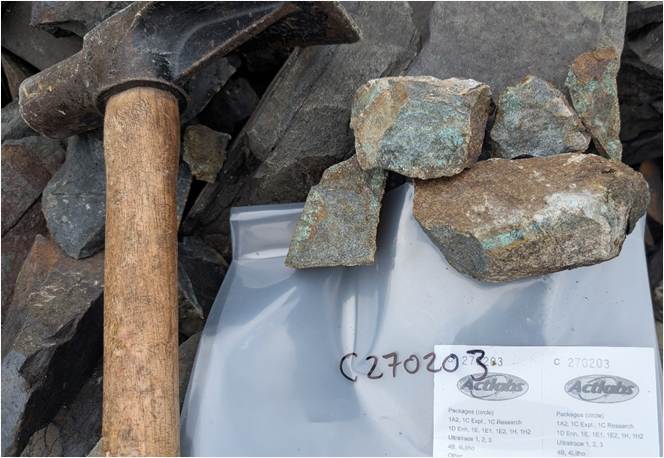
Figure 4: Quartzite boulders with disseminated chalcopyrite-bornite at the Clastic Showing, up to 3.7% Cu and 2.08 g/t Au.
Vein-hosted copper mineralization in the Upper Odjick clastic rocks and mafic sills returned interesting copper values in generally narrow (maximum 40 centimetre) quartz veins or dolomite veinlets. This style of mineralization was present at the Expert, Pass and Trek Showings (Figure 1). The highest copper value obtained from this style of mineralization was 2.39% at Pass, from quartz-dolomite veinlets with chalcopyrite (Figure 5). Gold values up to 306 ppb Au at Expert and 161 ppb Au at Trek were also obtained from this style of mineralization.
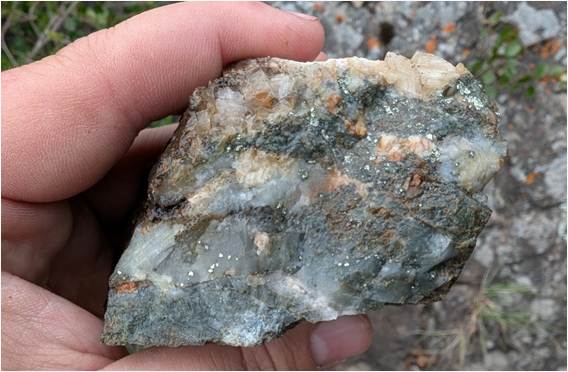
Figure 5: Dolomite-quartz veinlets with chalcopyrite at Pass Showing, up to 2.39% Cu.
Numerous new showings of >1% zinc-lead mineralization hosted in Lower Rocknest dolomites were discovered, including the Expert, Trio, Val, Bob, 3BD, KN, JM North and MT Showings (Figure 1). The best zinc value of 10.1% was obtained from the 3BD Showing from subcrop. The Bob and Val Showings in the western part of the Property, along the same trend, returned the best Pb values of the program of 17.8 and 13% respectively, along with up to 1.9% and 5.2% Zn respectively (Figure 6).
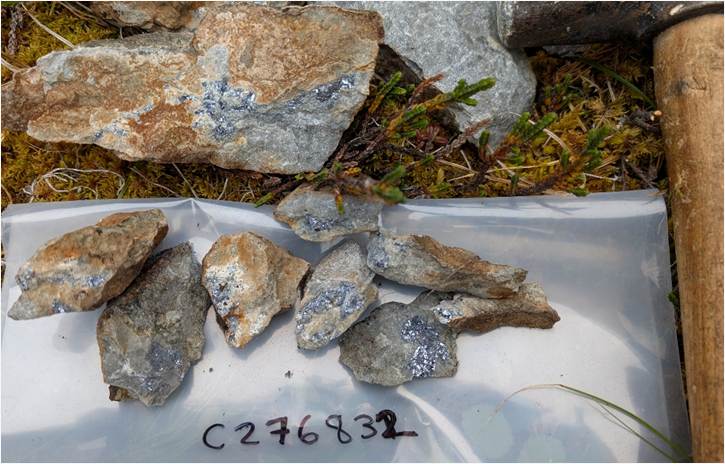
Figure 6: Galena mineralization in dolomite at Bob Showing, yielding up to 17.8% Pb and 1.9% Zn.
An important style of vein-hosted or disseminated Cu-Pb-Zn mineralization was discovered at the Hike Showing in clastic rocks of the Recluse group, with values up to 0.34% Cu (with 223 ppb Au), 3.75% Zn and 0.18% Pb in separate samples within the Recluse Group rocks. This supports the geologic model in which pyritic or graphitic shales act as traps for base-metal-bearing fluids. The Hike Showing is also spatially associated with both low-frequency and high-frequency conductive EM anomalies from the 2024 MobileMT Survey (see Figures 7 and 8). As the easily weathered (recessive) Recluse shales typically form topographic lows and therefore do not outcrop well compared to more competent rock units, the Hike Showing may be a difficult-to-find indicator of additional buried mineralization.
Many of the major new showings show good spatial correlation with both low- and high-frequency conductors. Expert, Alone, and Clastic are more marginal to the conductors, but their location is on the east margin of a syncline that dips towards the conductors. Most showings also occur along or proximal to the Rocknest-Odjick contact, as has been observed elsewhere on the Property.
The Company is integrating the new data into an anticipated 2026 drill program targeting both large and high-grade stratigraphic (sediment-hosted-style) Cu-Ag-Co mineralization as well as high-grade Ag-Cu veins.
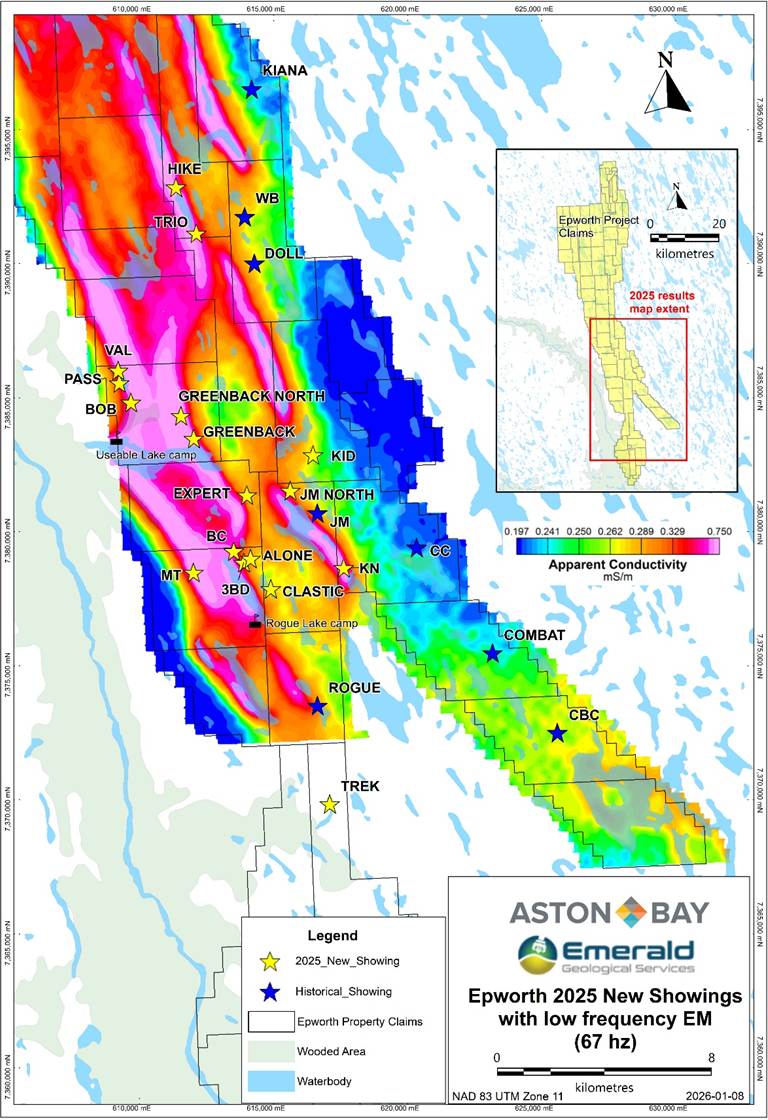
Figure 7: 2025 and historic showings overlain on low-frequency apparent conductivity (67 Hz) from the 2024 MobileMT survey, highlighting deeper (up to 900m) conductors.
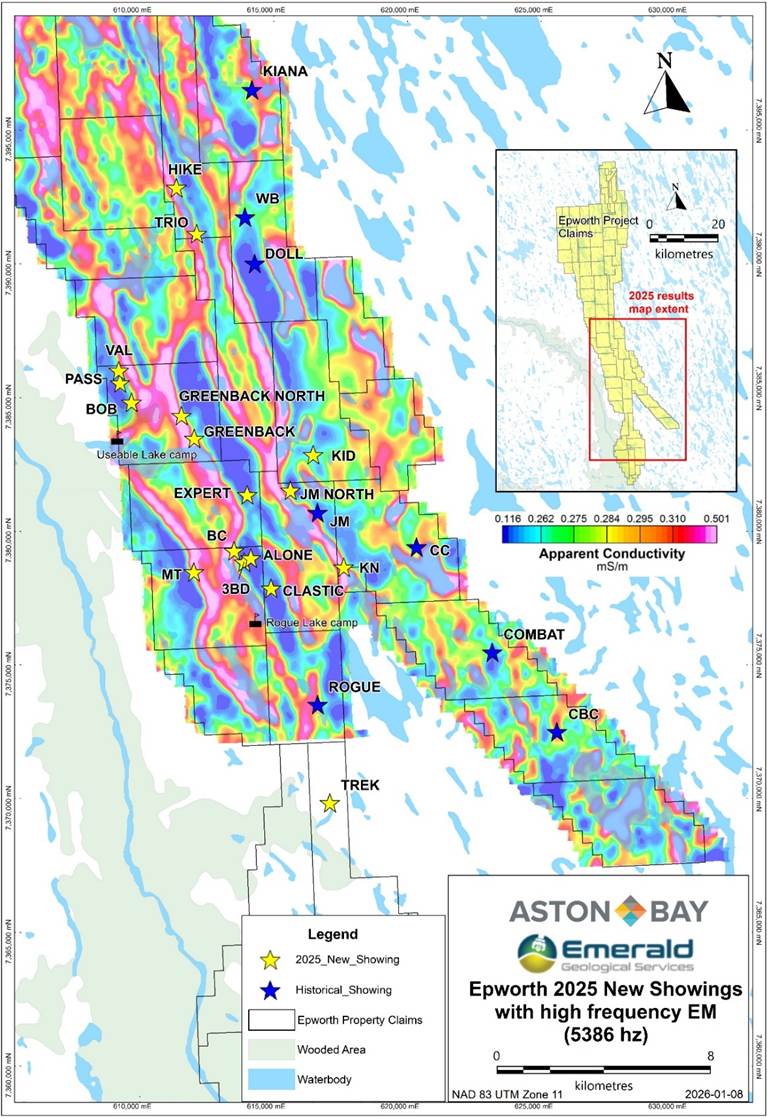
Figure 8: 2025 and historic showings overlain on high frequency apparent conductivity (5386 Hz) from the 2024 MobileMT survey, highlighting near-surface conductors.
Table 1: Epworth 2025 new showings.
Showing | Vein-hosted copper mineralization in Lower Rocknest dolomite | Disseminated copper-gold mineralization in Upper Odjick clastic rocks | Vein-hosted copper mineralization in Upper Odjick clastic rocks or mafic sills | Cu-Zn-Pb-Au mineralization in Recluse clastic rocks | Zinc-lead mineralization in Lower Rocknest dolomite | Comments |
|---|---|---|---|---|---|---|
Greenback | Dolomite subcrop with several 1-2 cm chalcocite veinlets. Assays between 5.21 and 29.2% Cu, 30.2 and 217 g/t Ag. | Within 5 m of east side of diabase dike. | ||||
Greenback North | Dolomite outcrop with 1% chalcopyrite stringers, 2.91% Cu assay. | Nearly 1 km along strike to NNW of Greenback. | ||||
BC | White dolomite outcrop and local float with locally up to 10% chalcocite stringers. Best assay of 3.17% Cu. | |||||
Kid | White dolomite outcrop with 3-4% chalcopyrite veinlets. 1.76% Cu, 131 ppb Au. | |||||
Expert | Dolomite with up to 3% chalcopyrite stringers in outcrop. Best assay of 0.34% Cu. | Shale and siltstone with 1-20% disseminated chalcopyrite, bornite and chalcocite in <1m zone along 25-meter minimum strike length. Assays of 0.32 to 5.42% Cu, 206 to 1890 ppb Au, 100 to 379 ppm Co. | Main QV traced for 80 meters in siltstone, 10-40 cm wide with up to 10% chalcopyrite, minor bornite and chalcocite. Assays up to 1.7% Cu, up to 306 ppb Au. Angular shale boulder 60 m south contained dolomite veinlets with 10% chalcocite, returning 1.84% Cu, 112 ppb Au. | Dolomite outcrop with sphalerite-galena stringers, best assays of 2.43% Zn and 1.74% Pb. | Copper mineralization identified along 200-meter strike length between the two major styles in outcrop. | |
Clastic | Small cluster of 1 m maximum angular boulders of quartzite and shale (contacts visible), locally magnetic with 1-3% disseminated chalcopyrite and bornite. Assays of 0.11 to 3.73% Cu, one gold anomaly of 2.08 g/t in quartzite. | In the boulder field along the Rocknest-Odjick contact valley. Numerous quartzite boulders with disseminated magnetite. | ||||
Alone | Rusty siltstone with 2-3% clots/cubes of pyrite in outcrop. | |||||
Pass | 1-2 cm dolomite veinlets hosting up to 5% chalcopyrite in fine-grained dark grey siliciclastics and/or mafic sills. Assays of 0.81 to 2.39% Cu. | Veining along fractures, possible E-W D4 fault on ridge. | ||||
Trek | Up to 10 cm quartz veining in shale with up to 3% sulphides, best assay of 0.26% Cu with 161 ppb Au. | 2 sites of anomalous samples 150 meters apart along strike. | ||||
Hike | Black shale with up to 3% sulphide stringers and disseminations. Best assays of 0.34% Cu (with 223 ppb Au), 0.18% Pb and 3.75% Zn in separate samples. | Anomalous samples collected along a 600-meter trend in outcrop, subcrop and float. | ||||
Trio | Sulphide veinlets in light-coloured dolomite, with best assays of 1.3% Zn and 0.59% Pb in separate samples. | Same trend as Hike, 1.3 km to SSE. Anomalous samples collected along an 80-meter trend in outcrop, subcrop and float. | ||||
Val | Dolomite outcrop with up to 10-20% stringers of galena and/or sphalerite. Best assays of 5.23% Zn and 13% Pb in separate samples. | 2 clusters of anomalous samples 100 meters apart in outcrop. | ||||
Bob | Dolomite subcrop with up to 5-10% galena. Best assays of 17.8% Pb and 1.92% Zn in separate samples. | Same trend as Val, 1.2 km along strike to SSE. | ||||
3BD | Dolomite with up to 3% pyrite and galena, quartz with dark banding, local angular float. Best assays of 10.1% Zn with 0.93% Pb. | |||||
KN | Dolomite with >10% sphalerite-galena from large angular float. 1.85% Zn, 0.57% Pb. 2.3 km along strike to SSE of historical JM showing. | |||||
JM North | Light grey dolomite in 1m+ angular float, moderate white quartz veining with up to 5% sphalerite-galena. 1.40 to 2.48% Zn, 1.2 to 2.05% Pb. Chips of gossanous frost heave 150 m south returned up to 0.13% Zn and up to 766 ppm Co. | |||||
MT | Dolomite on talus slope, 1.45% Pb and 0.51% Zn. |
Qualified Person
Michael Dufresne, M.Sc., P.Geol., P.Geo., and Coleman Robertson, B.Sc., P.Geo., are non-independent qualified persons as defined by National Instrument 43-101 and have reviewed and approved the scientific and technical information in this press release.
About the Epworth Property
The Epworth Property is located approximately 80 km southeast of the village of Kugluktuk (formerly Coppermine) in the Kitikmeot Region of Nunavut, Canada. The property is approximately 70 km from tidewater to the north. Logistical access is provided by float plane and helicopter from Kugluktuk and the city of Yellowknife <500 km to the south. The property consists of 85 claims covering an area of approximately 102,200 ha (252,542 acres) over a trend approximately 94 km in strike length and 20 km in lateral extent.
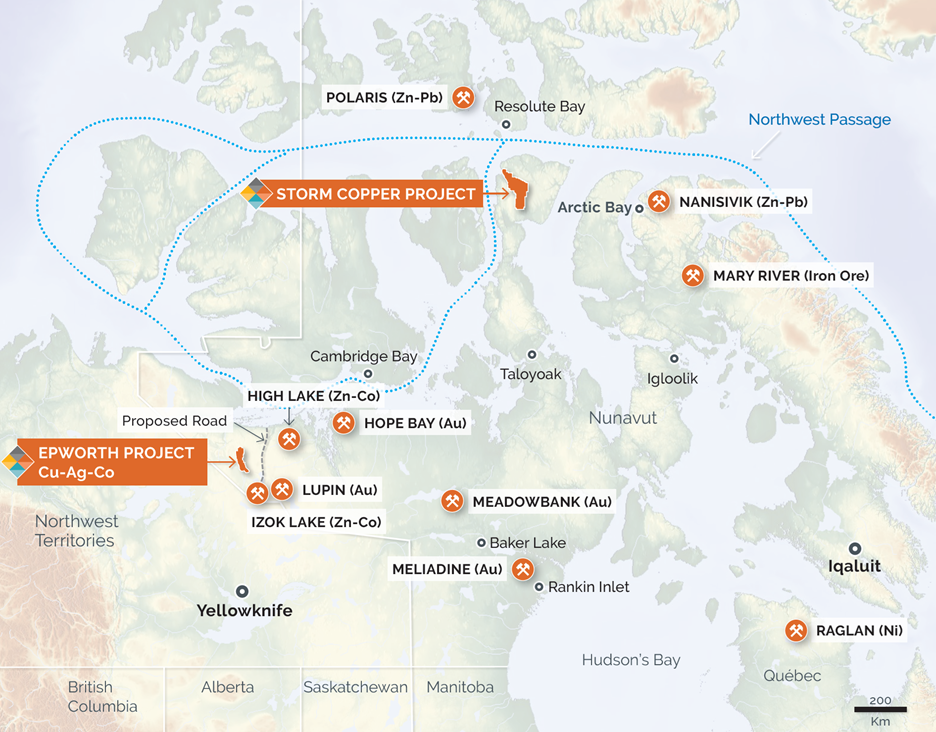
Figure 9: Location of the Epworth Property, Nunavut, Canada.
Agreement
Aston Bay has entered into an agreement with Emerald Geological Services under which Aston Bay can earn an 80% undivided interest in the Property by spending a minimum of $3 million in qualifying exploration expenditures over a four-year period. See Aston Bay April 24, 2024, news release for details of the agreement and Aston Bay June 4, 2025, news release for additional property details.
QA/QC Protocols
Grab samples at the Epworth Property were collected, documented and photographed in the field by Emerald Geological Services (EGS) personnel, then placed in sealed bags and periodically sent out by float plane from the camp to a secure location in Yellowknife. Subsequently, the sample bags, sealed with security tags, were shipped by transport to Activation Laboratories (ActLabs) in Thunder Bay, which is an ISO / IEC 17025 accredited laboratory. Grab sample collection is subject to EGS's internal quality assurance/quality control (QAQC) protocols, which include the insertion of certified reference material (CRM) into each batch of samples submitted. These CRMs consisted of OREAS 166, a high-grade sedimentary copper standard; OREAS 920b, a blend of barren slate and mine waste rock; OREAS 230, a low grade gold standard; OREAS 24d, barren basalt; OREAS 135b, a blend of black slate and Zn-Pb-Ag ores; and OREAS 24b, barren granodiorite.
Rock samples referenced in this news release were analyzed using ActLabs method "UT-6M," a 4-acid total digestion with ICP-OES/MS finish, yielding geochemical results for 48 elements. Samples with over-limit base metal results (>1%) were further analyzed using ActLabs method "8-4 Acid Total Digestion", a total digestion with ICP-OES finish, and lead samples >15% were further analyzed using ActLabs method "8-Peroxide ICP-OES," a sodium peroxide fusion with ICP finish. Samples with over-limit silver results (>100 ppm) were further analyzed using ActLabs method "8-Ag", a gravimetric fire assay. Most samples were also analyzed using ActLabs methods "1A2-50," a 50g fire assay with atomic absorption finish for gold, with over-limit results analyzed using method "1A3-50," a 50g fire assay with gravimetric finish. Select samples were analyzed using ActLabs method 1C-Exp, a gold-PGE fire assay with ICP-MS finish.
Reference:
Rees & Petrie, 1996: Report of 1995 Activities on the Epworth Joint Venture Project - 480, May 8th to 23rd and July 2nd to September 17th, Noranda Mining and Exploration Inc, Takijuq Lake - Tree River Area, N.W.T., Mackenzie Mining District, NTS 86I/10-15; 86J/9, 10, 15, 16; 86O/1-2, 7-9; 86P/1-12.
About Aston Bay Holdings
Aston Bay is a publicly traded mineral exploration company exploring for high-grade critical and precious metal deposits in North America. The Company is exploring the Storm Copper Property and Cu-Ag-Zn-Co Epworth Property in Nunavut.
FORWARD-LOOKING STATEMENTS
Statements made in this news release, including those regarding entering into the joint venture and each party's interest in the Project pursuant to the agreement in respect of the joint venture, management objectives, forecasts, estimates, expectations, or predictions of the future may constitute "forward-looking statement", which can be identified by the use of conditional or future tenses or by the use of such verbs as "believe", "expect", "may", "will", "should", "estimate", "anticipate", "project", "plan", and words of similar import, including variations thereof and negative forms. This press release contains forward-looking statements that reflect, as of the date of this press release, Aston Bay's expectations, estimates and projections about its operations, the mining industry and the economic environment in which it operates. Statements in this press release that are not supported by historical fact are forward-looking statements, meaning they involve risk, uncertainty and other factors that could cause actual results to differ materially from those expressed or implied by such forward-looking statements. Although Aston Bay believes that the assumptions inherent in the forward-looking statements are reasonable, undue reliance should not be placed on these statements, which apply only at the time of writing of this press release. Aston Bay disclaims any intention or obligation to update or revise any forward-looking statement, whether as a result of new information, future events or otherwise, except to the extent required by securities legislation.
Neither TSX Venture Exchange nor its regulation services provider (as that term is defined in policies of the TSX Venture Exchange) accepts responsibility for the adequacy or accuracy of this news release.
For more information contact:
Thomas Ullrich, Chief Executive Officer
thomas.ullrich@astonbayholdings.com
(416) 456-3516
Sofia Harquail, IR and Corporate Development
sofia.harquail@astonbayholdings.com
(647) 821-1337
SOURCE: Aston Bay Holdings Ltd.
View the original press release on ACCESS Newswire