

par Aton Resources, Inc. (CVE:AAN)
Aton Reports the First Results From Its Phase 3 RC Drilling Programme at the Semna Project, Including 14.33 g/t Au Over an Interval of 9 metres and 10.74 g/t Au Over 6 metres
VANCOUVER, BC / ACCESS Newswire / July 2, 2025 / Aton Resources Inc. (TSXV:AAN) ("Aton" or the "Company") updates investors on the results of its phase 3 reverse circulation percussion ("RC") drilling programme at the Semna gold mine project, located within the retained exploration areas of the Company's Abu Marawat Concession ("Abu Marawat" or the "Concession") in the Eastern Desert of Egypt.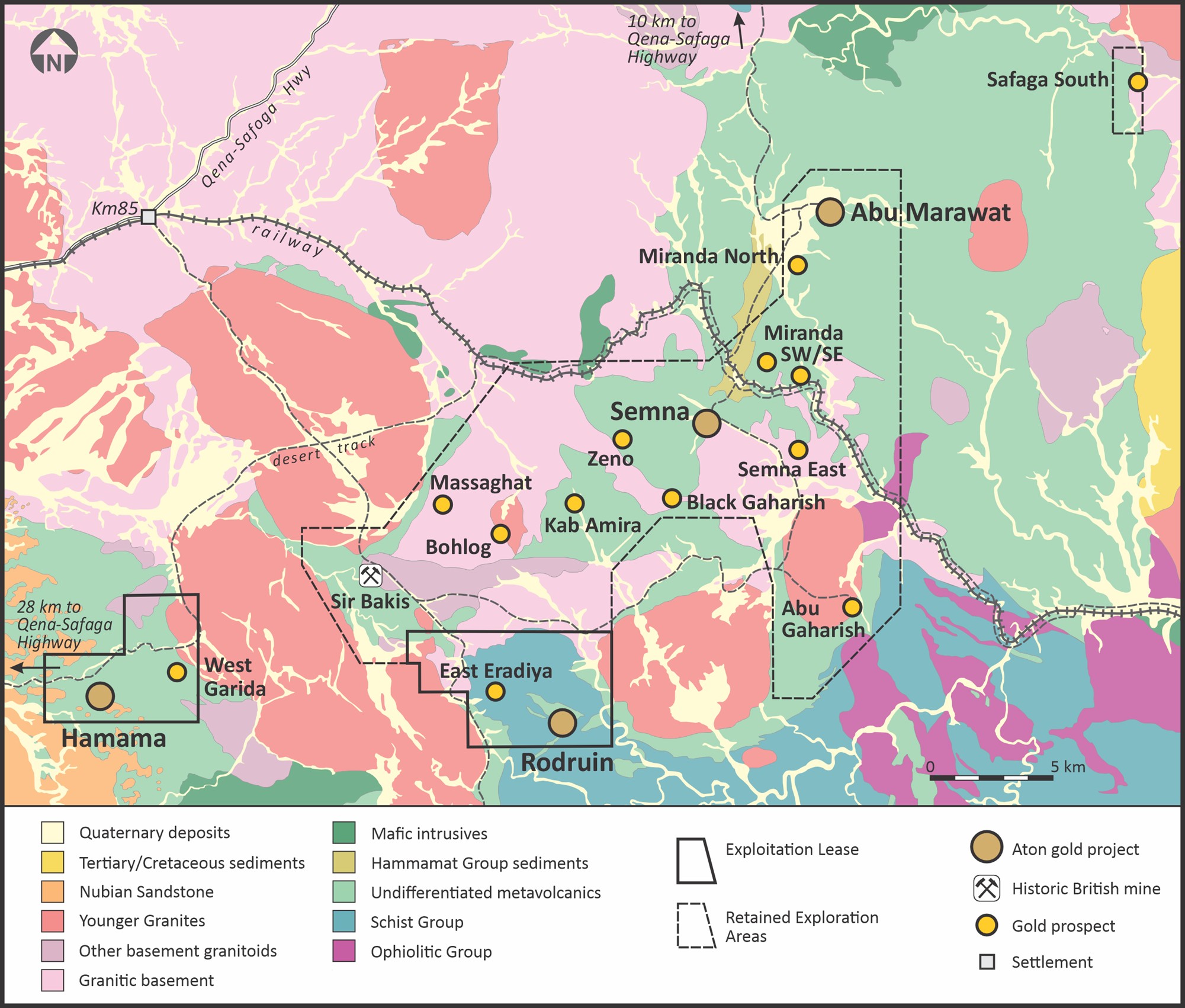
Highlights:
44 RC drill holes (SMP-049 to SMP-092) have been drilled in the current programme to date at Semna, for a total of 5,257m. Full assay results, including conventional fire assay and metallic screen fire assay results, are now available for the first 25 holes of the programme (SMP-049 to SMP-073);
Significant high grade mineralised intersections (based on screen fire assay analyses), returned to date, include the following:
14.33 g/t Au over a 9m interval, from 72m downhole depth, from hole SMP-050, including intervals of 46.50 g/t Au over 1m and 26.11 g/t Au over 3m;
5.41 g/t Au over a 14m interval, from 39m downhole depth, including an interval of 22.57m g/t Au over 3m (hole SMP-056);
10.74 g/t Au over a 6m interval, from 138m downhole depth (hole SMP-073);
8.66 g/t Au over a 7m interval, from 44m downhole depth, including an interval of 21.73m g/t Au over 2m (hole SMP-052);
10.06 g/t Au over a 3m interval, from 125m downhole depth (hole SMP-071);
6.16 g/t Au over a 6m interval, from 38m downhole depth (hole SMP-053).
"This latest set of very positive drilling results continues on from the previous programmes, further confirming the presence and persistence of the high grade veins at Semna, and we are really very happy with them" said Tonno Vahk, CEO. "We are currently pushing ahead at full speed with the objective of being able to include the Semna and Abu Marawat deposits in the PFS that we commenced last year, as Aton continues to work steadily towards its objective of developing multiple mining operations on the Abu Marawat Concession. We have also now completed the diamond drilling programme at Abu Marawat, and the rig will be mobilising to Hamama in the coming days to start on a short geotechnical and metallurgical drilling programme. We have temporarily suspended the RC drilling at Semna, with the rig also having been moved to Hamama to drill groundwater wells, as part of the vitally important programme to develop a process water supply for the projects. We plan to be back both RC and diamond drilling at Semna again within the next 2 months to continue on from the success of these latest results, and we will also be kicking off a follow-up RC drilling programme at Abu Marawat within the next 4 weeks."
Semna gold mine project
The Semna prospect is located approximately 27km east-northeast of the Hamama West deposit and 13km north-northeast of the Rodruin deposit, and is accessed via desert tracks from either Hamama, Rodruin or the Abu Marawat deposit to the north (Figure 1). The Semna area has a long history of gold mining, dating back thousands of years to the Old Kingdom, and it was more recently exploited between 1904 and 1906 by two British companies, which worked the Main Vein on two underground levels. It is anecdotally suggested that the Semna mine had the widest vein exploited during the early 20th Century phase of gold mining in Egypt, reaching up to 6m width in places, with the British companies reporting mining grades of over 2 ounces per ton. Reports from the British Mining Journal from 1905 indicated that some remnant pillars within the ancient Pharaonic-era stopes assayed up to 5.5 ounces per ton of gold. More recently the area has been extensively worked by illegal artisanal miners, who have now been removed from the site.
Figure 1: Geology plan of the Abu Marawat Concession, showing the location of the Semna prospect
During 2023 Aton completed a first phase of RC drilling at Semna, drilling 21 holes for a total of 3,662 metres. This initial programme yielded excellent results with mineralised intersections including 50.07 g/t Au over a 6m interval (hole SMP-016), 28.36 g/t Au over a 4m interval (hole SMP-003), 10.61 g/t Au over a 9m interval (hole SMP-019), and 5.73 g/t Au over a 14m interval (hole SMP-017). The RC drilling confirmed the presence of significant coarse gold in the Semna mineralisation (see news release dated December 18, 2023).
Subsequent metallurgical testwork undertaken by Aton returned very positive results with gold recoveries in excess of 97% from 2 representative bulk samples of the Semna mineralisation. Gold was also recovered to 2 gravity concentrates at rates of 56.4% and 62.2%, again indicating a significant component of coarse gold in the Semna mineralisation. The testwork indicated that the Semna mineralisation is amenable to treatment by both conventional CIL, and gravity concentration-leach processing options (see news release dated January 4, 2024).
In 2024 the Company completed a 27 hole follow up diamond drilling programme for a total of 4,701 metres drilled (see news release dated July 4, 2024). This programme also returned significant high grade intersections including 11.69 g/t Au over a 5.19m interval, from 126.35m downhole depth, and 21.53 g/t Au over a 1.50m interval, from 147.20m (both from hole SMD-048), 15.05 g/t Auover a 2.55m interval, from 100.45m (hole SMD-025), 27.90 g/t Au over a 1.37m interval, from 68.94m (hole SMD-043), 8.10 g/t Au over a 3.13m mineral, from 135.83m (hole SMD-027), and 16.77 g/t Au over a 1.55m interval, from 64.30m (hole SMD-044).
The mineralisation at Semna is interpreted as being orogenic in style, and is associated with an array of structures, presumed to have formed in dilational zones, accompanied by shearing and weak to moderate phyllic wall rock alteration. The mineralised structures appear to be localised between and offset by a series of regional north-northeast striking faults. These structures are frequently manifested as milky white quartz veins, which apparently anastomose and pinch and swell, and are associated with locally strong phyllic wall rock alteration. The quartz veins are variably sulphidic, and the highest grades of gold mineralisation are typically associated with lenses and selvages of sulphide minerals, sub-parallel to the veins, as well as occurring at the margins of the veins, and in the immediately adjacent altered wall rocks. The mineralisation at Semna predominantly consists only of gold, which is often coarse and nuggety. The sheared veins locally contain abundant chalcopyrite, and can carry significantly elevated grades of silver and copper.
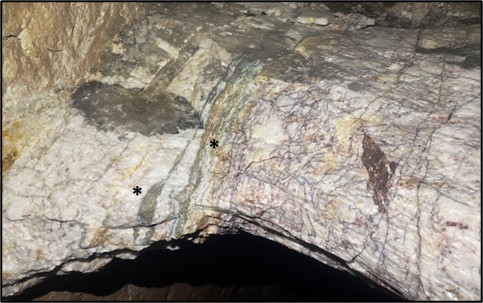
Figure 2: Remnant rib pillar of theMain Vein in the underground workings, showing lenses and ribbons of vein-parallel sulphidic material (*)
Semna phase 3 RC drilling programme
To date 44 RC drill holes (SMP-049 to SMP-092) have been drilled in the current programme, for a total of 5,257 metres (Figure 3). The current phase 3 Semna RC programme has been temporarily suspended, as the RC rig has been moved to Hamama for other priority work on the Hamama Pre-Feasibility Study. Once this is completed the rig will carry out a c. 5,000m programme of RC drilling at Abu Marawat, before returning to Semna.
The phase 3 RC drilling has initially been undertaken on a reasonably tight spacing as the Company looks to accelerate the estimation of a maiden resource at Semna, while considering the grade variability and the irregular distribution of the nuggety coarse gold in the pinching and swelling veins, as well as continuing to test the eastern and depth extensions of the identified mineralisation. Full collar details of all holes are provided in Appendix A.
Samples were initially composited over 4m intervals, with the entire length of all the drill holes being submitted for gold fire assay analysis. Selected 1m split samples collected directly during the drilling were subsequently submitted for additional gold fire assay analysis, as well as for silver and copper analysis, after the receipt of the 4m composite assay results. After receipt of the 1m split assay results a further 165 selected 1m splits from the drilling were also submitted for metallic screen fire assay analysis, comprising most of the samples from within the mineralised intervals.
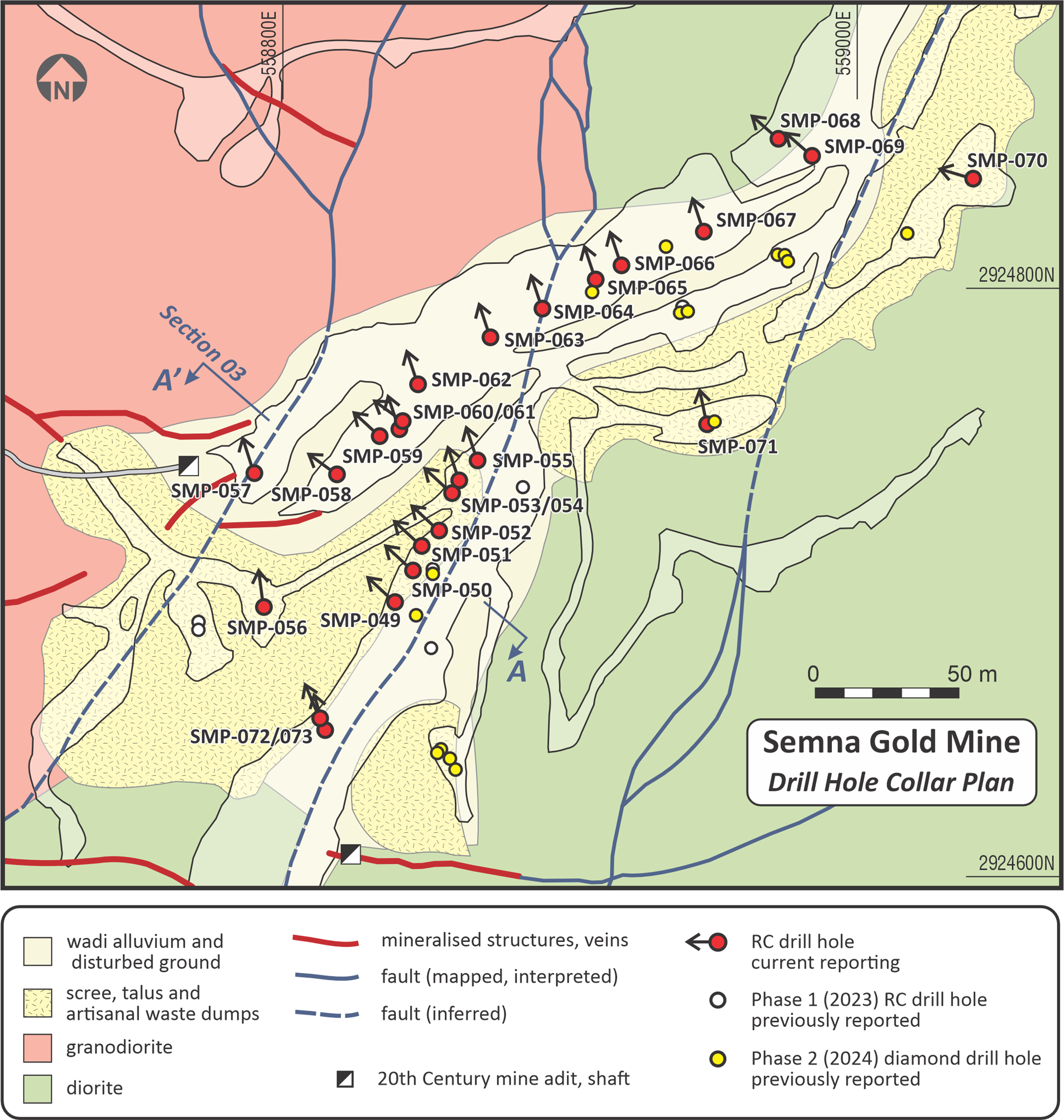
Figure 3: Geology and drill hole collar plan of the Semna prospect, SMP-049 to SMP-073
Discussion of results
Selected mineralised intersections from holes SMP-049 to SMP-073 are shown below in Table 1. Full mineralised intersection details from SMP-049 to SMP-073 are provided in Appendices B, C, and D (based on screen fire assay analyses, conventional fire assay analyses from the 1m split samples, and conventional fire assay analyses from the 4m composite samples, respectively).
Hole ID | Intersection (m) | Au 1 (g/t) | Ag (g/t) | Cu (ppm) | Comments | ||
From | To | Interval | |||||
SMP-050 | 72 | 81 | 9 | 14.33 | 2.2 | 29 | Fire assay: 9m @ 13.39 g/t Au |
incl. | 75 | 76 | 1 | 46.50 | 6.7 | 62 | |
and incl. | 75 | 78 | 3 | 26.11 | 3.6 | 26 | |
SMP-051 | 35 | 49 | 14 | 2.93 | 0.7 | 68 | Fire assay: 14m @ 2.60 g/t Au |
incl. | 44 | 49 | 5 | 7.65 | 1.7 | 73 | |
SMP-052 | 44 | 51 | 7 | 8.66 | 1.4 | 19 | Fire assay: 7m @ 10.52 g/t Au |
incl. | 49 | 51 | 2 | 21.73 | 3.9 | 23 | |
SMP-053 | 38 | 44 | 6 | 6.16 | 0.8 | 39 | Fire assay: 6m @ 7.79 g/t Au |
SMP-056 | 39 | 53 | 14 | 5.41 | 1.1 | 39 | Fire assay: 14m @ 6.97 g/t Au |
incl. | 50 | 53 | 3 | 22.57 | 4.3 | 36 | |
SMP-058 | 1 | 10 | 9 | 1.85 | 0.3 | 338 | Fire assay: 9m @ 1.92 g/t Au |
incl. | 5 | 6 | 1 | 11.65 | 0.6 | 242 | |
SMP-066 | 30 | 40 | 10 | 1.99 | 2.9 | 158 | Fire assay: 10m @ 2.11 g/t Au |
SMP-069 | 77 | 81 | 4 | 3.98 | 3.3 | 2,097 | Fire assay: 4m @ 5.33 g/t Au |
SMP-071 | 125 | 128 | 3 | 10.06 | 0.8 | 22 | Fire assay: 3m @ 5.14 g/t Au |
incl. | 125 | 126 | 1 | 29.10 | 2.1 | 34 | |
SMP-073 | 138 | 144 | 6 | 10.74 | 1.9 | 16 | Fire assay: 6m @ 12.29 g/t Au |
incl. | 138 | 139 | 1 | 35.20 | 6.7 | 55 | |
Notes:
| |||||||
Table 1: Selected final intersections from the Semna phase 3 RC drilling, SMP-049 to SMP-073
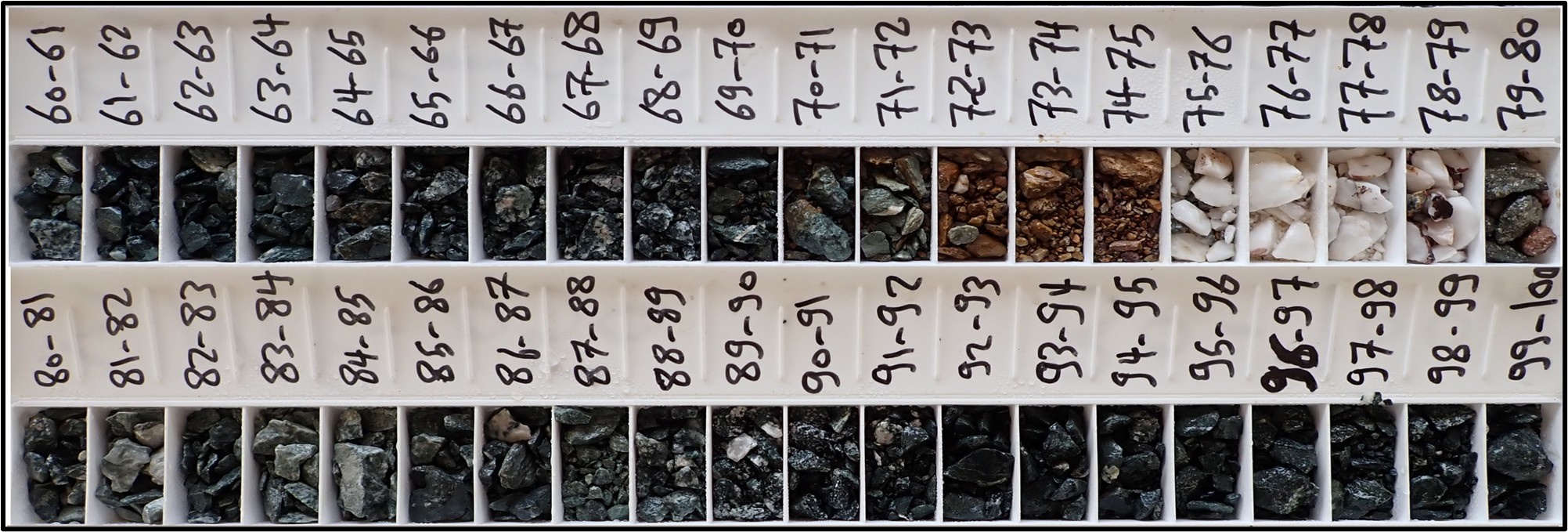
Figure 4: RC percussion chips from hole SMP-050, 60-100m depth, showing the mineralised interval between 72-81m, associated with a massive white quartz vein
The latest phase of RC drilling continues to indicate that the gold mineralisation is usually associated with the milky white quartz veins, with gold appearing to be distributed both within the quartz veins themselves, but usually at lower grades, and typically also at higher grades in the sulphide-bearing margins and wall rock adjacent to the veins, as was mapped in the underground workings (Figures 2, 4 above and 5 below). Note that in hole SMP-050 (Figure 4) the highest grades returned come from the immediate margins of the quartz vein: 45.6 g/t Au between 75-76m and 61.8 g/t Au between 79-80m. The same is noted in hole SMP-073 (Figure 5), with the highest grades also returned from margins of the quartz vein: 35.2 g/t Au between 138-139m and 13.5 g/t Au between 142-143m.
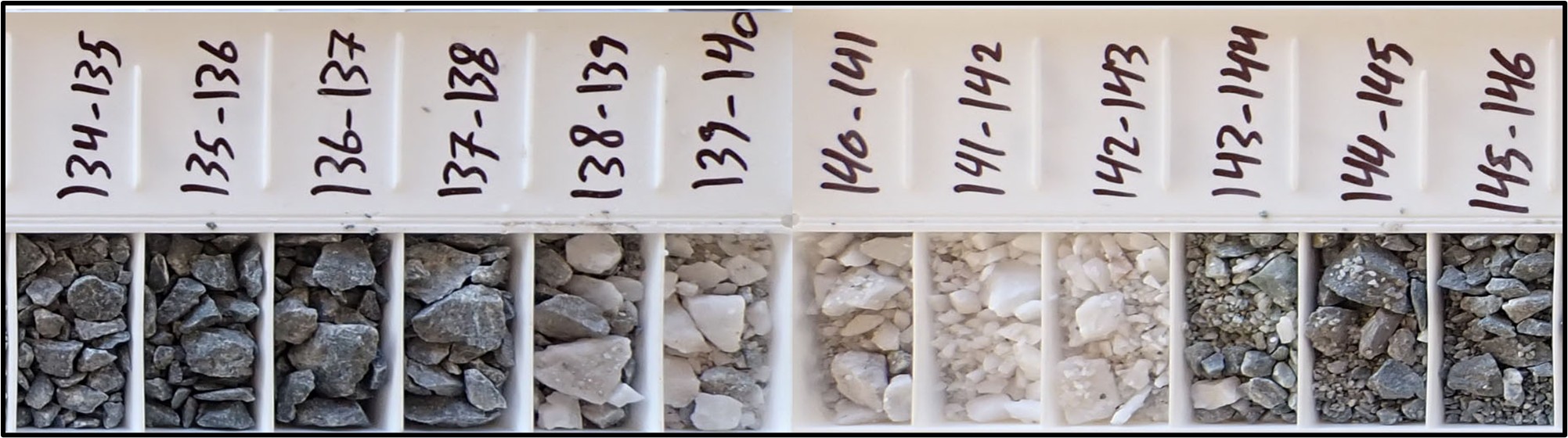
Figure 5: RC percussion chips from hole SMP-073, 134-146m depth, showing the mineralised interval between 138-144m, also associated with a massive white quartz vein
The quartz veins themselves can be either virtually barren or weakly mineralised (eg. SMP-050: 0.30 g/t Au between 76-78m, see Figure 4), or well mineralised (eg. SMP-073: 6.85 g/t Au between 140-142m, see Figure 5). However there does appear to be a fairly clear correlation between the gold grades and the quantity of sulphide present in the veins themselves, and on their margins.
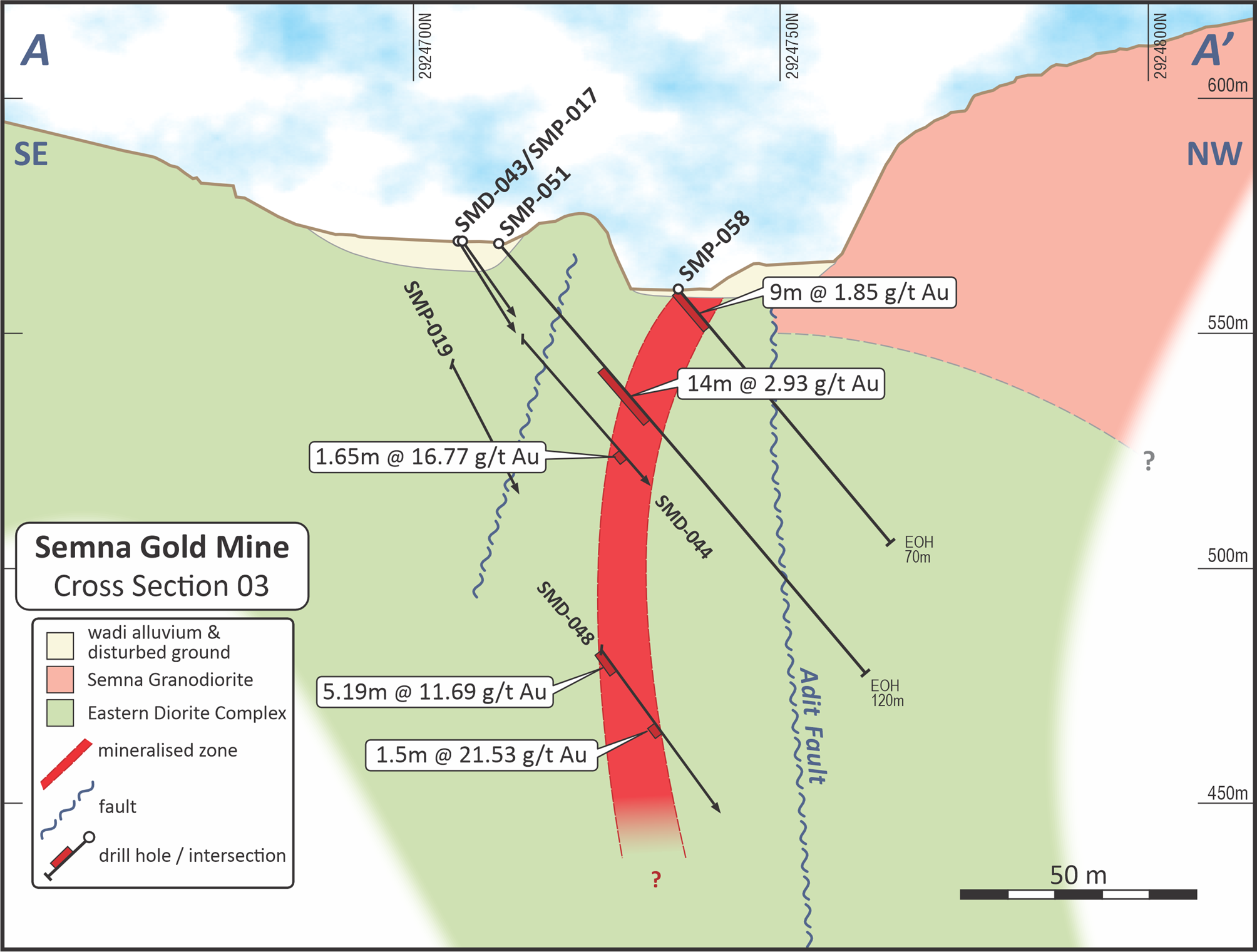
Figure 6: Cross-section O3 through the eastern extension of the Semna deposit (refer to Figure 2 for location)
The latest phase of drilling continues to indicate the presence of a sub-vertical zone of multiple quartz veins in the area tested, which appear to be largely sub-parallel, over a true width of approximately 20m (Figure 6). There is also increasing evidence from the drilling of the presence of a series of well mineralised "flat" easterly-dipping structures, as mapped at surface in channel sample profile SMC-065, which returned a mineralised interval at surface of 2.60 g/t Au over 39.3 metres (see news release dated February 1, 2024). Surface mapping and evidence from drill holes suggest that the "flat-dipping" veins to be quite narrow, in contrast to the steep milky quartz veins, which reach several metres in width. The "flat-dipping" veins rarely exceed 10-20cm in width individually, but numerous stacked tension gash style veins occur in these structural zones. Anecdotally these "flat-dipping" vein arrays appear to be associated with elevated copper grades.
Sampling methodology and analysis
Please also refer to the "Sampling and analytical procedures" section below for fuller details of these procedures.
The drilling was undertaken by Capital Limited, using an Explorac 100 RC drilling rig with an onboard cone splitter. The onboard splitter was set to produce 2 sub-samples of the chips ("L" and "R" samples, collected in cloth bags) each representing c. 12.5% of the entire sample over a metre interval. The remaining c. 75% of the sample was collected in bulk plastic bags at the rig. Sampling of each and every hole was undertaken in their entirety at 1 metre intervals.
Hole SMP-050 | ||||||
Depth (m) | 4m composites | 1m splits | Screen fire assays | |||
From | To | Au (g/t) 1 | Au (g/t) 2 | Ag (g/t) | Cu (ppm) | Au (g/t) 3 |
68 | 69 | 0.03 | 0.01 | <0.2 | 20 | - |
69 | 70 | 0.01 | <0.2 | 25 | - | |
70 | 71 | 0.05 | <0.2 | 53 | - | |
71 | 72 | 0.06 | <0.2 | 40 | - | |
72 | 73 < | |||||