

par FireFox Gold Corp (NASDAQ:FFOXF)
FireFox Gold Adds Deeper Mineralization at the Northeast Zone and Extends the East Zone at the Mustajärvi Project, Finland
SODANKYLA, FINLAND / ACCESS Newswire / May 5, 2026 / FireFox Gold Corp. (TSXV:FFOX)(OTCQB:FFOXF)("FireFox" or the "Company") is pleased to report additional assay results and observations from the ongoing drill program at the Company's 100%-held Mustajärvi Gold Project in Lapland, Finland. In this release, FireFox is reporting results from the Northeast and East Zones, as well as the Mustajärvi West target.
Drill hole 26MJ005 at the Northeast Zone tested for deeper extensions of a high-grade gold zone (first reported in 2021) and intersected 11.0 metres at 4.9 g/t gold from 301.5 metres downhole. The hole also hit several other lower grade intervals, opening the southern and deeper parts of the Northeast Zone for more follow-up drilling (Figure 2).
In step-out drilling at the East Zone, drill hole 26MJ004 extended the zone by 50 metres to the northeast with intercepts such as 3.0 metres at 1.51 g/t gold, 4.3 metres at 1.5 g/t gold, and 3.2 metres at 1.12 g/t gold - all from less than 100 metres depth. The Company added three more holes with narrow lower grade intercepts from grid drilling on the south side of the East Zone (Figure 1 and Table 1).
FireFox drilling has also moved into the gap between the East and Northeast Zones, where two holes have just been logged, sampled, and sent for assay. Company geologists have documented the presence of visible gold at a depth of 112.3 metres in one of these holes (26MJ012). In 26MJ010, the drill encountered semi-massive to massive pyrite mineralized quartz breccia over 6.0 metres beginning immediately below thin glacial overburden (Figures 3 and 4). Such quartz-pyrite breccias commonly contain significant gold at the Mustajärvi project. The Company cautions, however, that assays are not yet available for these intervals, so there can be no assurance of significant gold mineralization in these two drill holes.
This release also includes results from four reconnaissance drill holes that encountered minor narrow mineralization, well to the southwest from known mineralization at the previously undrilled Mustajärvi West target (Figure 1).
Carl Löfberg, FireFox's CEO, commented on the new results, "Our team is doing an incredible job moving the drill around the Mustajärvi property, both filling in the grid around the discovery zones and testing far flung exploration targets. This drill hole from deeper within the Northeast Zone is very significant because it bulks out this deeper lobe of mineralization with a successful follow-up on a narrow high-grade intercept from 2021. The structural controls here are very complex, but the pattern in the drilling suggests that narrow high-grade gold often ties into thicker bodies of mineralization. Given this encouragement, we are excited to bring the drill back to the Northeast Zone and to fill in the gap between it and the East Zone. We are making great progress towards a maiden mineral resource estimate, and this hole 26MJ005 gives us added confidence that the newly enlarged Northeast Zone will be part of that resource."
This work is part of the ongoing diamond drill program at Mustajärvi, which is expected to exceed 10,000 metres before the end of spring 2026. The program mixes infill and step-out drilling at existing mineralized zones and tests some new targets both proximal and distal to the main mineralized structures.
Mustajärvi Project and Drill Program Summary
The Mustajärvi Project lies along the highway between the cities of Kittilä and Sodankylä, approximately 17 kilometres east of Kittilä. FireFox and predecessor companies drilled approximately 15,752 metres prior to commencement of the current program, and drilling delineated three different lodes of gold mineralization along more than two kilometres of strike. Inclusive of these drill holes, the total drilling on the project is now 23,809 metres.
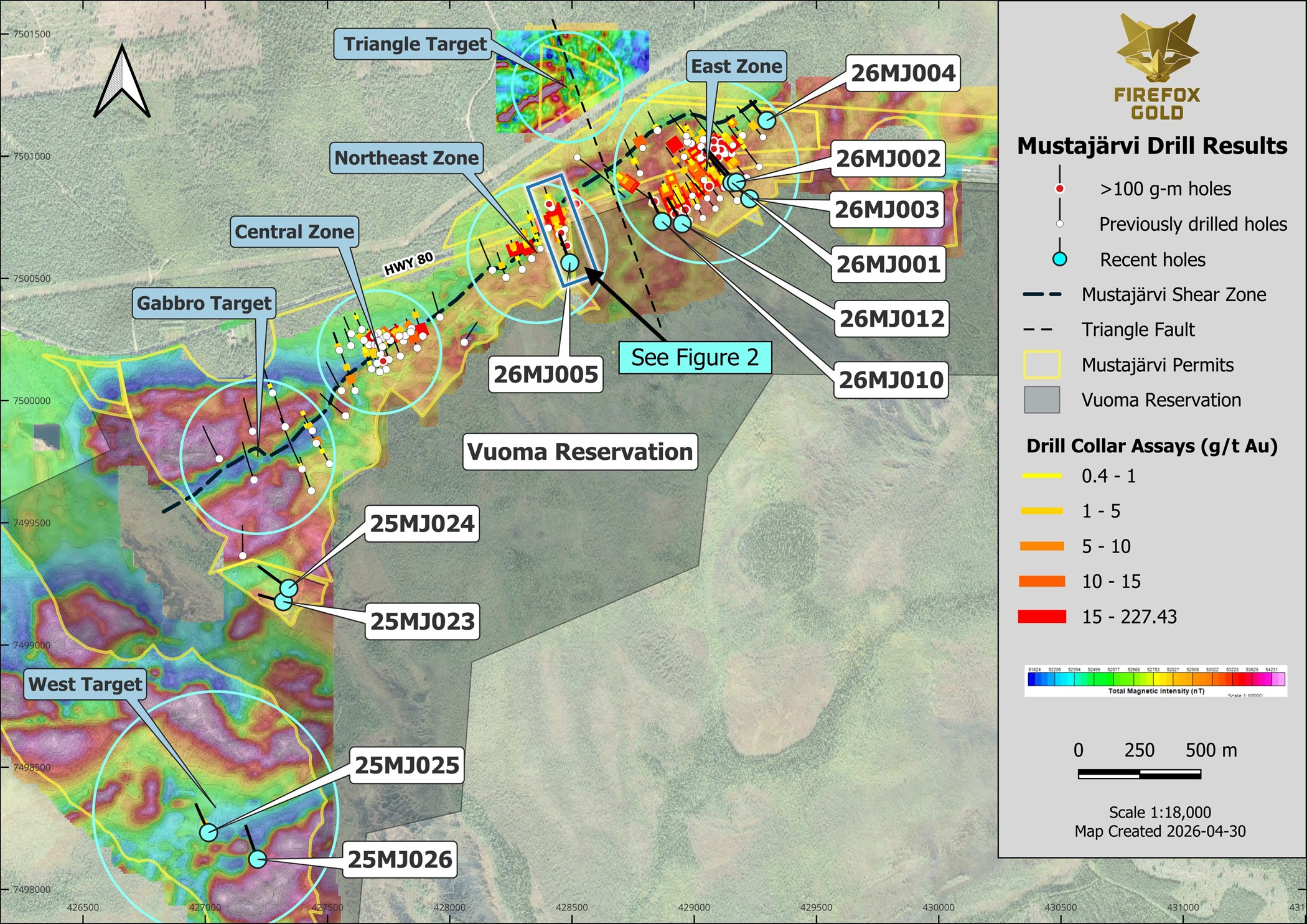
Figure 1. Mustajärvi Project area with the location of drill holes 25MJ023 through 26MJ005 and 26MJ012.
Mustajärvi Northeast Zone
Drill hole 26MJ005targeted the deep high-grade gold mineralization at the Northeast Zone previously intercepted with hole 21MJ014, which included 1.5m at 45.85 g/t gold from 168.5m depth, including 0.5m at 130.5 g/t gold, and 0.8m averaging 13.01 g/t gold at 335.65m depth (see Company news release dated January 25, 2022). The new hole was directed at the opposite azimuth (340°), in line with most of the drilling in the Northeast and East Zones. The hole was collared in thin glacial sediments (approximately 3.7 metres deep) and intersected the contact between Savukoski ultramafic volcanic rocks and Sodankyla metasediments at 126.3 metres downhole.
The targeted zone was encountered at 301.5 metres downhole and returned 11.0 metres averaging 4.9 g/t gold, including 1.0 metre at 46.7 g/t. The mineralization is associated with quartz-pyrite-tourmaline veining, including a 30-cm-thick section of semi-massive pyrite at the top of the interval. The dominant host rocks are moderately to strongly albite-altered metasediments and tuffites. Above this mineralization, there are mafic volcanic units and significant evidence of faulting and shearing.
Lower grade intervals (up to 9 metre intervals above the cutoff grade of 0.3 g/t gold) occurred in several places in this drill hole, usually related to quartz-carbonate-tourmaline-pyrite (QCTP) veins crosscutting moderately to intensely albite-sericite altered metasedimentary rocks. This hole is noteworthy for its long intervals of sodic alteration and abundant tourmaline, including near-massive tourmalinite breccia at approximately 376 metres downhole.
Mustajärvi East Zone
In recent weeks, the drill has been filling in a nominal 50-metre grid along the southern margins of the known mineralization (26MJ001 - 26MJ003). These results also include drill hole 26MJ004, which steps out 50 metres northeast from any previous drilling along a projection of the Mustajärvi Shear Zone (MSZ). The hole tested and successfully verified the continuation of the interpreted MSZ to the northeast. This extension to the mineralized system extends the strike length of meaningful drill intercepts from Northeast Zone through the East Zone to more than 1.2 kilometres.
Hole 26MJ004 cut through several gold-mineralized intervals, starting at 51.7 metres downhole, where a QCTP vein yielded 0.8 metres at 1.6 g/t gold. Results from deeper in the hole include:
3.0 metres averaging 1.51 g/t gold from 64.3 metres;
4.3 metres averaging 1.5 g/t gold from 79.7 metres; and
3.2 metres averaging 1.12 g/t gold from 103.1 metres depth.
These intervals are associated with strongly albite-sericite altered intermediate tuffites with common QCTP veinlets and disseminated pyrite. The deeper intercept included more intensive tourmaline veining and infill. The drill is expected to return to test this area further, as Company geologists have done very little work here.
Holes 26MJ001 and 26MJ003 were drilled in a fence towards the northwest on the south side of the East Zone. The holes were designed to fill gaps in the geological model in anticipation of resource modelling. Drill hole 26MJ001 was collared in the hangingwall ultramafic volcanic rocks and penetrated the contact into the underlying metasediments and tuffites at approximately 89 metres. The hole encountered several narrow zones of low to moderate grade including:
1.0 metre at 2.1 g/t gold from 93.0 metres;
2.0 metres at 4.07 g/t gold from 130.2 metres;
2.0 metres at 5.08 g/t gold from 135.2 metres;
1.0 metre at 1.07 g/t gold from 202.4 metres; and
1.0 metre at 1.81 g/t gold.
As observed in other holes on the south side of the zone, the mineralization is often punctuated by narrow mafic dikes or sills cutting through the metasedimentary and tuffite lithologies. The result is sometimes these narrow, stacked intercepts. The alteration is consistent in this area, however, intense albite alteration cut by QCTP veins and sometimes flooded with pyrite and tourmaline. There appears to be more deformation in the sediments as this hole goes deeper.
Drill hole 26MJ003was collared approximately 100 metres to the southeast from 25MJ001 in relatively deep glacial sediments (approximately 23.4 metres deep). This hole reached the contact between ultramafic volcanic rocks and metasediments at 210.8 metres downhole. The hole encountered several low-grade intervals at and below 236.0 metres downhole (See Table 1).
Hole 26MJ002 was collared approximately 20 metres to east from hole 26MJ001 and targeted a gap in the geological model. The hole cut through the contact between ultramafic volcanic rocks and metasediments at 100.4 metres downhole and intercepted several narrow, lower grade intervals. The best of which was 4.3 g/t Au over 0.7 metres from 149.0 metres depth. Mineralization is associated with quartz-pyrite veins and QCTP veins and disseminated pyrite within albite altered metasediments.
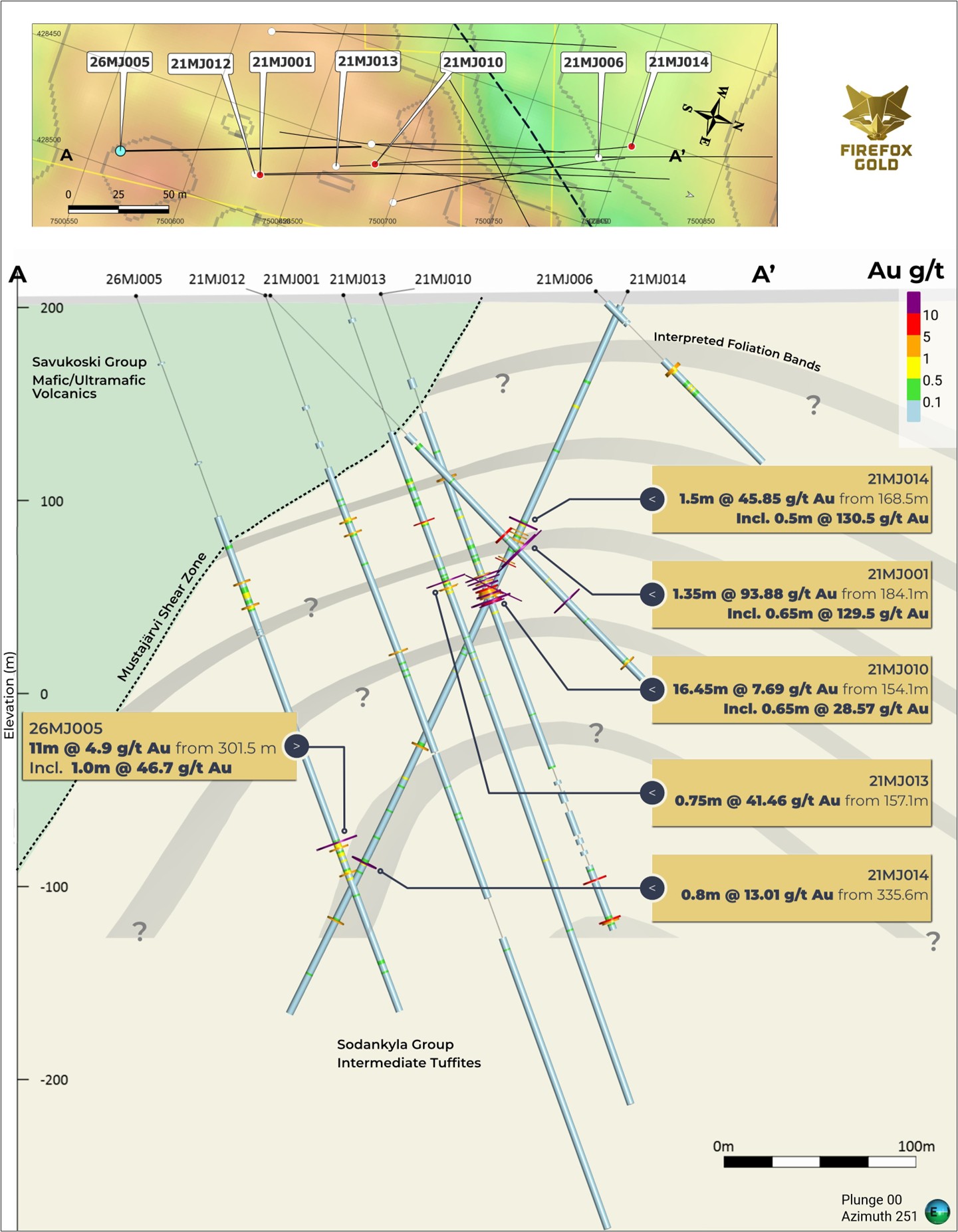
Figure 2. Preliminary Cross Section through Northeast Zone with New Drillhole.
Visibly Mineralized Drill Holes with Assays Pending
Drill hole 26MJ012 was collared approximately 50 metres southeast from drill hole 25MJ005 and designed to test the continuation of the mineralization to depth. Drill hole 25MJ005 was one of the best holes on the project to date (see Company news release dated December 8, 2025).
26MJ012 was collared in thin glacial sediments (3.7m) and entered the Savukoski group ultramafic volcanics before intersecting a strongly pyrite-mineralized lithological contact at 80.7 metres depth. This zone of mineralization at the contact continued for approximately three metres and was comprised of massive to semi-massive pyrite veins and clots filling open space as well as the matrix of a quartz-carbonate-tourmaline breccia (Figure 3). The hole then passed into a narrow strongly foliated mafic dike before re-emerging into more massive pyrite mineralization from 85.50-89.80 metres downhole. Farther downhole at 97-120 metres, the rock is pervasively albitized, silicified, and selectively replaced with pyrite. Here the pyrite occurs as stringers along foliation (bedding), veins, fracture filling, and semi-massive clots. Senior FireFox geologists observed visible gold flakes related to the pyrite replacement zone at approximately 112.30 metres downhole. They also confirmed the mineral as gold with a portable XRF instrument. The size of the observed gold grain within the pyrite matrix is approximately 0.5 millimetres in width (Figure 3.) At the time of this writing, drilling continues on hole 26MJ012.
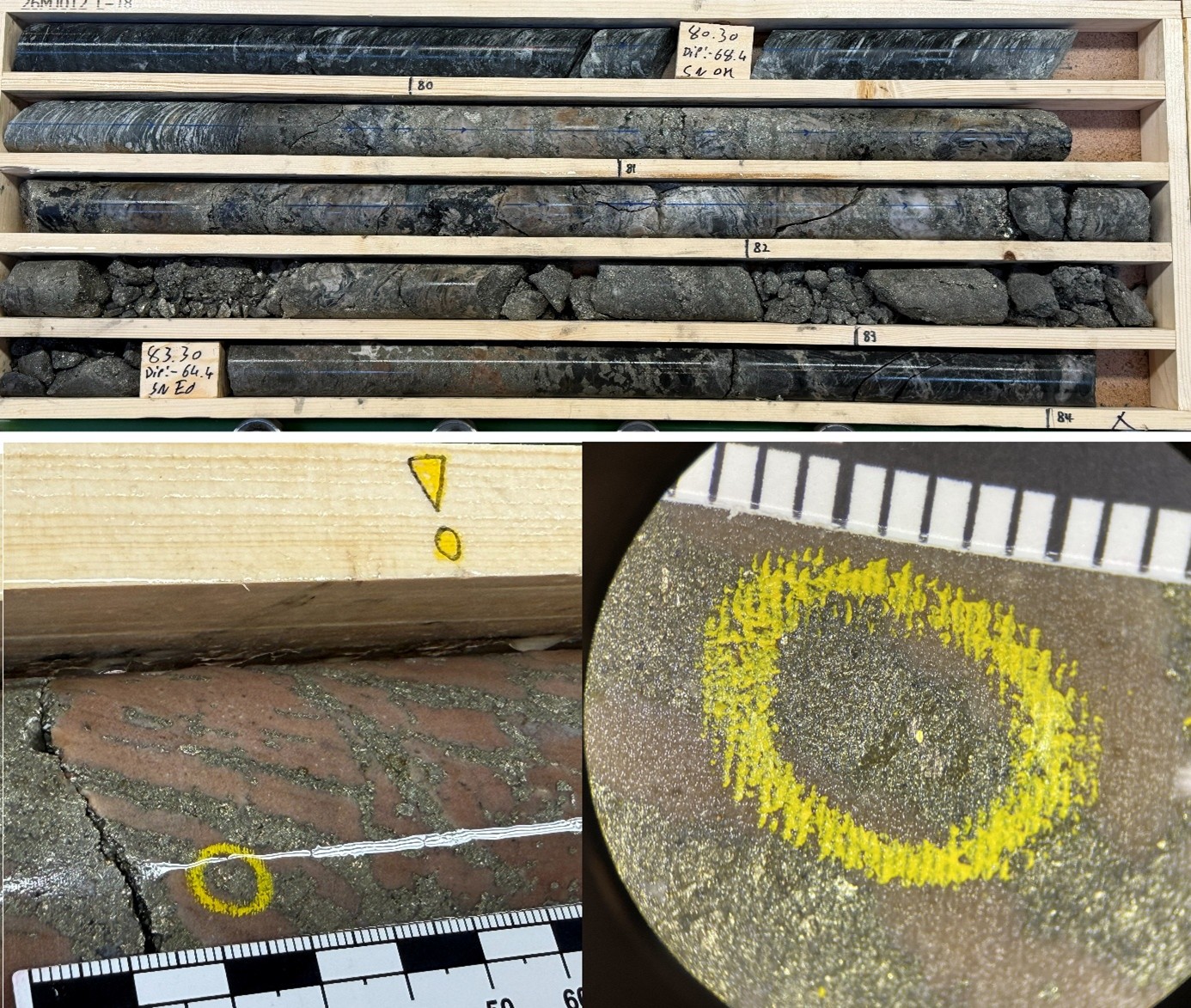
Figure 3. Pyrite mineralization and visible gold in 26MJ012. Upper image shows the mineralized contact between ultramafic volcanics and massive pyrite. Lower image shows albitized and silicified metasediment with replacement-style pyrite and gold grain.
Drill hole 26MJ010 was collared 62 metres southwest from drill hole 25MJ005 and 82 metres west from drill hole 26MJ012. This drill hole passed directly into strongly pyrite-mineralized quartz breccia immediately beneath the glacial sediment overburden from 7.4 metres to 13.4 metres downhole (Figure 4). Such massive pyrite and quartz breccias have been shown to be highly mineralized with gold in previous drilling at Mustajärvi.
However, the company cautions that such qualitative assessments of gold mineralization cannot be relied upon since assays are not yet available.
It is not yet clear if this this alteration and mineralization is a continuation from drillholes 25MJ005 or 25MJ012, or whether this is a new zone.
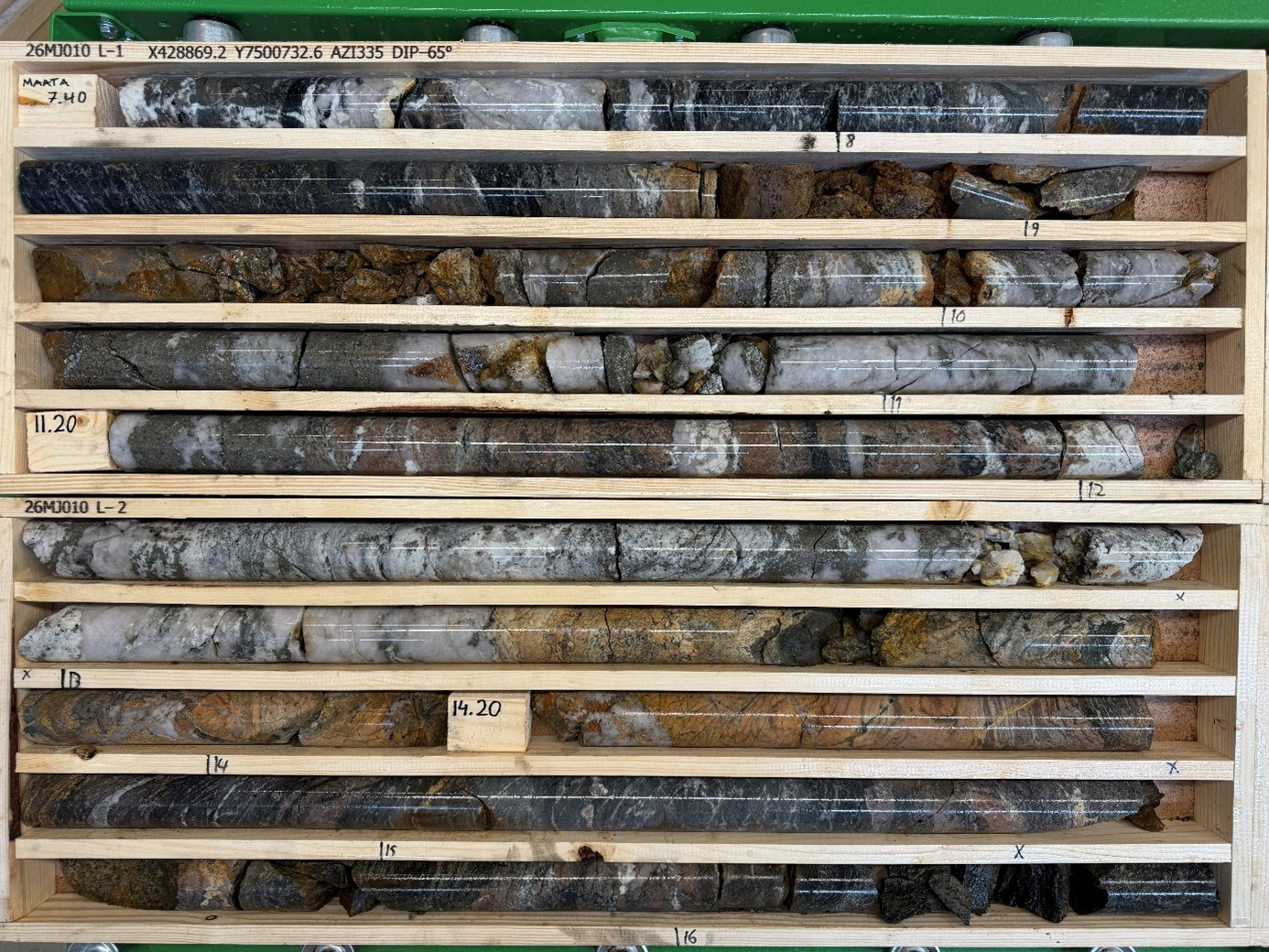
Figure 4. Near surface pyrite and quartz mineralization observed in drill hole 26MJ010.
Reconnaissance Drilling at the West Target
Drill holes 25MJ023-25MJ026 are the first scout holes to test the Mustajärvi West Target. This is an area where the MSZ has been projected to continue, and the major regional Venejoki Shear Zone is also projected to pass through. These are considered prospective structures for exploration, but there has been no previous drilling in the area. The Company has collected detailed ground magnetics and base-of-till (BoT) samples over much of the area. Prospective targets in this area may include magnetic lows (indicating possible hydrothermal alteration), linear patterns in the geophysics (suggesting faults or shear zones), and/or anomalous gold or multielement geochemistry in the BoT samples - or some combination of the above. Mineralization along the MSZ at the Central, Northeast, and East Zones is commonly associated with linear or oblate magnetic lows and accompanying but often widespread BoT gold anomalies.
The glacial overburden in parts of Mustajärvi West is deeper than at the main Mustajärvi permit area. This means anomalies may be more subtle or different in nature. Nevertheless, the Company reported a gold anomaly in BoT sampling of more than 100 g/t on January 12, 2026 near where the Mustajärvi and Venejoki shear zones are interpreted to intersect. Drill holes 25MJ025 and 25MJ026 were designed to test this combined structural and geochemical target.
Drill hole 25MJ025 was collared in relatively deep glacial sediments (approximately 21.3 metres deep) and passed through a contact between ultramafic volcanic rocks and metasediments at 32.2 metres downhole. The hole intercepted two narrow gold mineralized intervals: the first starting from 59.5 metres downhole and returning 0.7 metres at 1.06 g/t gold; and a second interval yielding 0.8 metres at 0.38 g/t gold from 73.6 metres downhole. Notably, the hole also encountered several narrow, low-grade intervals with gold values between 0.1-0.3 g/t gold. Mineralization is associated with quartz-carbonate veins with patchy pyrite mineralization hosted in strongly albite-altered intermediate tuffites.
Drill hole 25MJ026was collared approximately 230 metres to the southwest from hole 25MJ025 and targeted similar structural targets and a cluster of BoT anomalies. The drill hole cut through a package of strongly altered metasediments but did not return any significant gold mineralization.
Drill holes 25MJ023 and 25MJ024 targeted discrete magnetic highs and magnetic gradients (transitions from highly magnetic to less magnetic rocks) that also coincide with anomalous BoT samples, a similar pattern to that seen at the East and Northeast Zones. The holes cut through a package of metasedimentary rocks and mafic intrusive dykes but did not return any significant gold mineralization.
Table 1. Selected Drill Intercepts in Drill holes 25MJ016 - 25MJ022
(Cut-off Grade 0.3 g/t Au)
Drill Hole | From (m) | To (m) | Interval (m) | Au Grade (g/t) | |
25MJ023 | No significant results | ||||
25MJ024 | No significant results | ||||
25MJ025 | 59.5 | 60.2 | 0.7 | 1.06 | |
73.6 | 74.4 | 0.8 | 0.38 | ||
25MJ026 | No significant results | ||||
26MJ001 | 93.0 | 94.0 | 1.0 | 2.10 | |
98.0 | 100.0 | 2.0 | 0.55 | ||
130.2 | 132.2 | 2.0 | 4.07 | ||
135.2 | 137.2 | 2.0 | 5.08 | ||
169.0 | 171.0 | 2.0 | 0.58 | ||
202.4 | 204.1 | 1.7 | 1.07 | ||
224.0 | 225.0 | 1.0 | 1.81 | ||
26MJ002 | 110.0 | 111.0 | 1.0 | 0.75 | |
117.0 | 118.0 | 1.0 | 0.64 | ||
131.0 | 132.0 | 1.0 | 0.33 | ||
149.0 | 149.7 | 0.7 | 4.30 | ||
167.0 | 168.0 | 1.0 | 2.04 | ||
212.6 | 214.6 | 2.0 | 0.59 | ||
216.6 | 217.6 | 1.0 | 0.59 | ||
223.4 | 225.2 | 1.8 | 0.45 | ||
26MJ003 | 236.0 | 237.0 | 1.0 | 0.37 | |
240.0 | 241.0 | 1.0 | 0.55 | ||
244.0 | 249.0 | 5.0 | 0.81 | ||
257.0 | 258.0 | 1.0 | 0.33 | ||
275.0 | 281.2 | 6.2 | 0.38 | ||
287.2 | 290.2 | 3.0 | 0.32 | ||
304.0 | 305.0 | 1.0 | 0.48 | ||
315.0 | 318.0 | 3.0 | 0.36 | ||
330.0 | 330.8 | 0.8 | 0.42 | ||
26MJ004 | 51.7 | 52.5 | 0.8 | 1.60 | |
64.3 | 67.3 | 3.0 | 1.51 | ||
72.0 | 73.0 | 1.0 | 0.64 | ||
75.0 | 76.0 | ||||