

par GSMA
[MWC 2026] GSMA Releases Experience Specifications for AI Calling Native Applications
EQS-News: GSMA / Key word(s): Miscellaneous/Miscellaneous
[MWC 2026] GSMA Releases Experience Specifications for AI Calling Native Applications
12.03.2026 / 06:30 CET/CEST
The issuer is solely responsible for the content of this announcement.
BARCELONA, Spain, March 12, 2026 /PRNewswire/ -- At the 5G Futures Summit hosted by GSMA during MWC Barcelona 2026, GSMA released the white paper Gigauplink, Deterministic Latency, and Network Evolution for the Mobile AI Era. The white paper outlines the development and evolution trends, application scenarios, and business models for operators' native voice services in the mobile AI era. It also elaborates on specifications for evaluating AI Calling experiences, helping operators build voice experience-centric networks and significantly improve the user experiences of voice services.
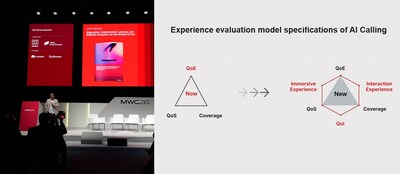
The white paper points out that, driven by the synergy between 5G-A and AI, mobile communications have entered the mobile AI era. Operators are transforming native voice services from conventional voice calls into AI voice calls. By integrating AI algorithms and computing power into the native IMS voice network, conventional voice calls are evolving towards enhanced services and innovative applications. This evolution will bring users stable, HD, visual, intelligent, and efficient next-generation calling experiences. Emerging AI calling services, such as AI immersive calling and AI interactive calling, pose new requirements on network connectivity and AI capabilities.
According to the white paper, AI-based noise reduction is a typical application of AI immersive calling. By leveraging AI algorithms to eliminate ambient noises in various scenarios, operators can deliver clearer native calls and provide users with more immersive experiences. The AI-based noise reduction algorithms can be used in various scenarios, such as offices (noise level > 40 dB), streets (noise level > 60 dB), and construction sites (noise level > 80 dB) to enable users to enjoy high-quality voice services without relying on terminals. AI-powered real-time translation is a typical application of AI interactive calling. Thanks to the enhancement of voice network capabilities, longstanding language barriers are being eliminated. AI Calling can provide accurate and real-time voice transcription or translation during video calls, effectively helping business people who participate in international online conferences, tourists who travel to foreign countries, and people with hearing impairments.
As highlighted in the white paper, operators can integrate AI capabilities into native voice services to upgrade the business model, infusing daily calling with new vibrancy. Users can enjoy AI-driven enhanced functions during conventional calls after paying their subscription, enabling operators to transform single-dimensional traffic monetization into multidimensional experience monetization.
In AI Calling scenarios, how to measure user experiences is a new challenge for operators. The white paper systematically defines the experience evaluation model specifications of AI Calling. In addition to three experience indicators (QoE, QoS, and coverage) of conventional HD voice services, another three indicators—AI immersive experiences, AI interactive experiences, and QoI—are added to the experience evaluation model specifications of AI Calling. Immersive calling can greatly improve the user experiences of basic voice calls. For example, the MOS and SNR are significantly increased. Interactive calling requires the network to be equipped with new interaction channels and capabilities, including Data Channel (DC) and Video Channel (VC), delivering enhanced experiences, such as screen sharing, real-time translation, and interaction with agents. QoI is a key indicator for measuring the intelligence of the voice network. The measurement encompasses high-quality AI models, flexible AI management, AI-based network/user status awareness and decision-making, and inclusive AI service capabilities. These can provide basic network assurance for voice experience upgrades.
The ITU has initiated a work project named P.AI-MOS to evaluate the user experiences of multimodal AI applications, while the proposals for AI Calling voice experience standards are under research. To accelerate the development of the experience evaluation model, GSMA and industry partners are calling for collective efforts to establish rules that map the key quality indicators (KQIs) of AI applications to the key performance indicators (KPIs) of networks. These efforts aim to fast-track the formulation of mobile AI service experience standards, providing stronger support for the advancement of the mobile AI industry.
Photo - https://mma.prnewswire.com/media/2932226/image1.jpg
 View original content:https://www.prnewswire.co.uk/news-releases/mwc-2026-gsma-releases-experience-specifications-for-ai-calling-native-applications-302711905.html

12.03.2026 CET/CEST Dissemination of a Corporate News, transmitted by EQS News - a service of EQS Group.
The issuer is solely responsible for the content of this announcement.
The EQS Distribution Services include Regulatory Announcements, Financial/Corporate News and Press Releases.
View original content: EQS News
2290070 12.03.2026 CET/CEST