

par Trifecta Gold Ltd. (CVE:TG)
Trifecta Gold Completes Rye Drill Program and Provides Exploration Update
- 6 holes totalling 1,852 m drilled at the Rye Project with assays expected in early October.
- Surface rock sampling up to 19.25 g/t gold from prospecting at Rye.
- Additional sheeted quartz veining discovered at Liam.
VANCOUVER, BC / ACCESS Newswire / September 15, 2026 / Trifecta Gold Ltd. (TSXV:TG)(OTCQB:TRRFF) ("Trifecta" or the "Company") has completed its 2026 drill campaign at the Rye Project, as well as surface work at the Liam and Lois projects, three of eleven Tombstone Gold Belt targets where the Company is earning a 100% interest from Strategic Metals Ltd. These projects cover established Reduced Intrusion-Related Gold System ("RIRGS") targets that share the same geological characteristics as significant gold mines and deposits in Yukon and Alaska.
Rye
The Rye Project is situated 14 km from the North Canol Road between two mid-Cretaceous granitic intrusions, which are important mineralizers for gold deposits and occurrences along Yukon's Tombstone Gold Belt. It lies in the eastern portion of the belt, 20 km south of Fireweed Metals Ltd.'s ("Fireweed") MacPass Project and within the TÅ« ÅÄ«Ìdlini portion of the Kaska Nation's traditional territory. Fireweed is currently advancing a design plan for upgrading the North Canol Road, supported by funding through Natural Resources Canada's First and Last Mile Fund, formerly the Critical Minerals Infrastructure Fund.
The 2026 Rye campaign comprised 6 diamond drill holes from 5 locations, totalling 1,852 metres. RY-26-07 was collared 300 m north of RY-25-01, which yielded 1.98 g/t gold over 15 m. It targeted the same zone of sheeted veining approximately 200 m down-dip from hole RY-25-01 and cut sheeted veining with a similar density to that hole, but with increased amounts of scheelite and bismuthinite. Three of the holes targeted a steep, west-dipping fault, referred to as the Empire Fault, that extends along a known 1.5 km strike length. RY-26-08 and -09 were collared 140 m northeast of hole RY-25-04, which bottomed in 1.97 m grading 1,465 g/t silver, 0.22% copper and 0.97% WOâ. A third hole, RY-26-11, was directed toward the fault where it is observed on surface as a gold-bearing, arsenopyrite-healed breccia. This hole cut several altered dykes hosting quartz-tourmaline veins before intersecting a 15 m wide fault zone of intense brecciation, silicification and re-brecciation.
RY-26-10 was collared 230 m west-southwest from RY-25-01 and directed towards an area of elevated gold soil and rock geochemistry, along with a section of quartz veins outcropping near the margin of the Itsi Pluton. RY-26-12 was collared within the Itsi Pluton and designed to test the roof zone of the intrusion, down-dip of gold-bearing veins that are observed within the overlying hornfelsed wallrock. All the core has been logged, split and shipped to the ALS assay prep lab in Whitehorse, Yukon and the Company expects assay results in early October.
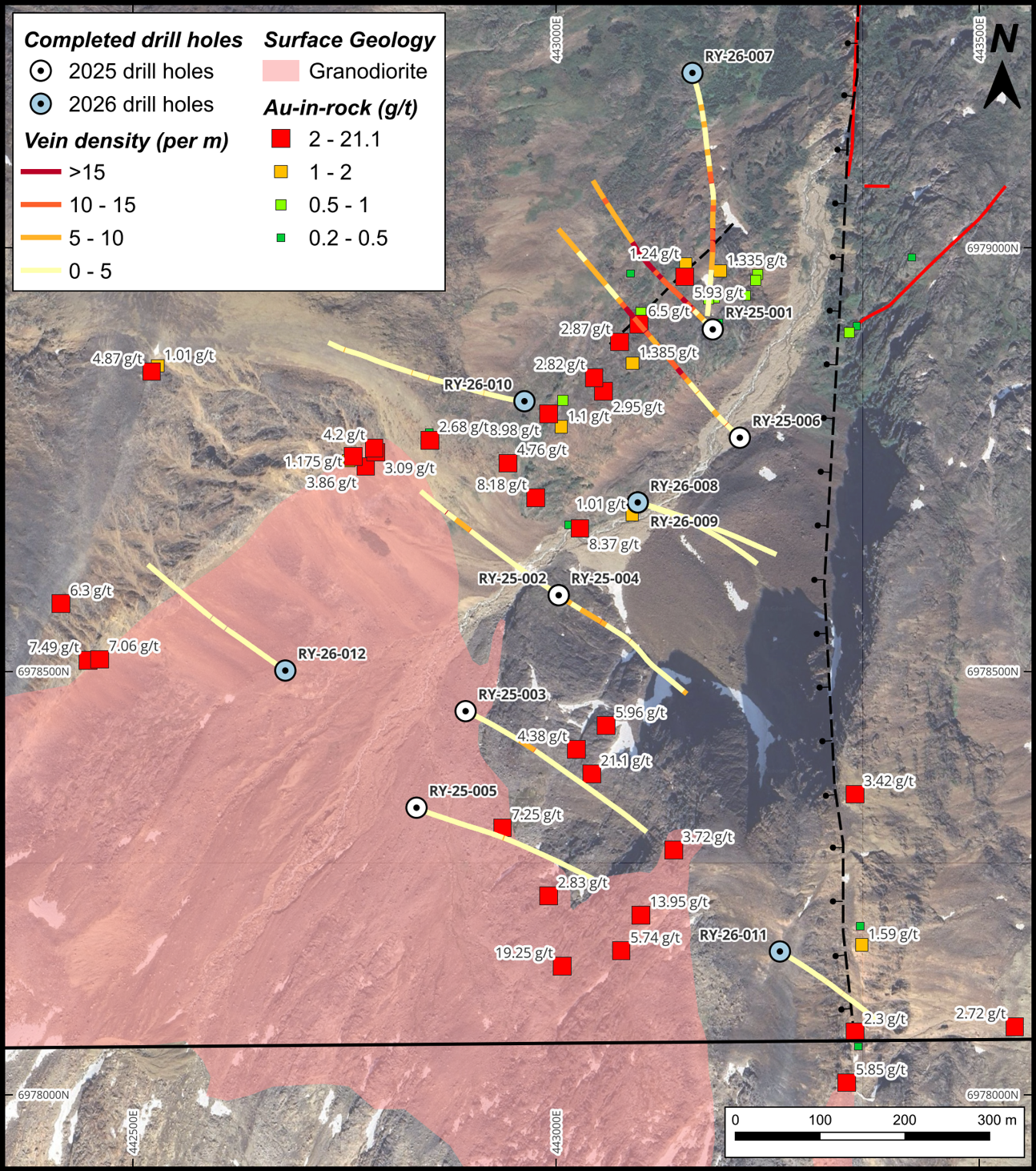
Figure 1 - Rye Project 2025 and 2026 drill holes plotted thematically with vein density, along with gold-in-rock values
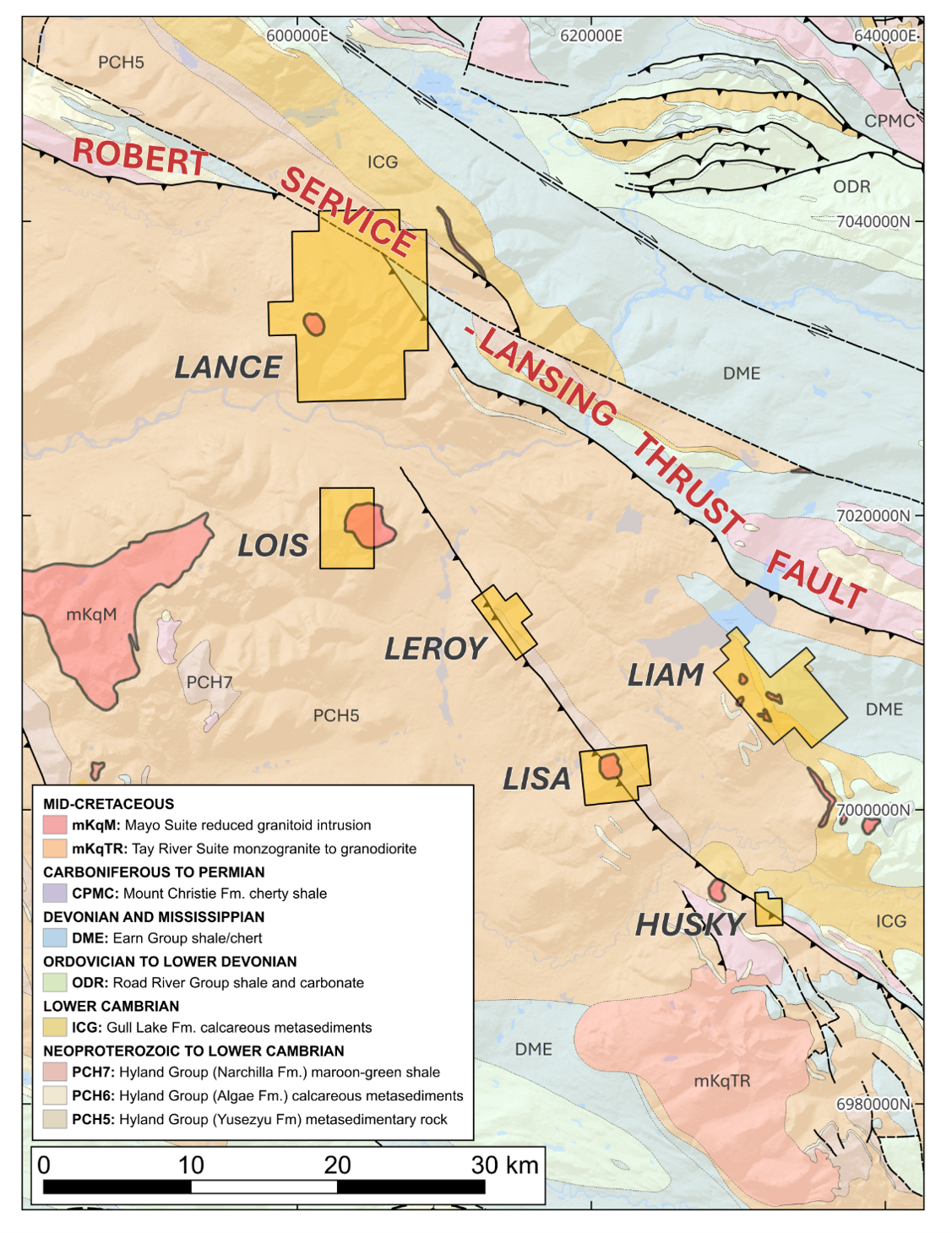
Figure 2 - Lansing area geology and project locations
The Liam and Lois projects both cover large, multi-element soil anomalies located within the hanging wall of the Robert Service Thrust Fault, a major, northerly-verging thrust fault that extends from north-central Yukon approximately 400 km into east-central Yukon. Significant gold deposits and occurrences in north-central Yukon are spatially associated with the fault. Banyan Gold Corp.'s AurMac Deposit straddles the fault, while the past-producing Eagle Gold Mine, Sitka Gold Corp.'s RC Gold Project, and the ML Project are hosted principally in Hyland Group metasedimentary rock within the hanging wall thrust sheet.
Liam
Copper- and gold-bearing skarn mineralization at Liam is associated with several mid-Cretaceous aged, granitic stocks and dykes exposed at surface, and is overprinted by arsenopyrite-bearing quartz veins where rock samples have yielded 2.12 g/t gold, 174 g/t silver, 0.51% copper, 5.84% lead, 2.59% zinc and 4.1% antimony from a single sample. A positive magnetic response surrounding the small granitic bodies on the property suggests there has been minimal erosion of the hornfelsed cupola above a larger buried intrusion - a positive setting for exploration because it implies that the mineralized system is preserved.
The project covers three parallel, gold-copper-silver soil anomalies, with coincident bismuth, tellurium, arsenic and antimony, which remain open in both directions along strike. Field work in 2026 focussed on developing future drill targets within these anomalies and successfully identified areas of intensely sheeted veining in one of the granitic stocks, as photographed below.
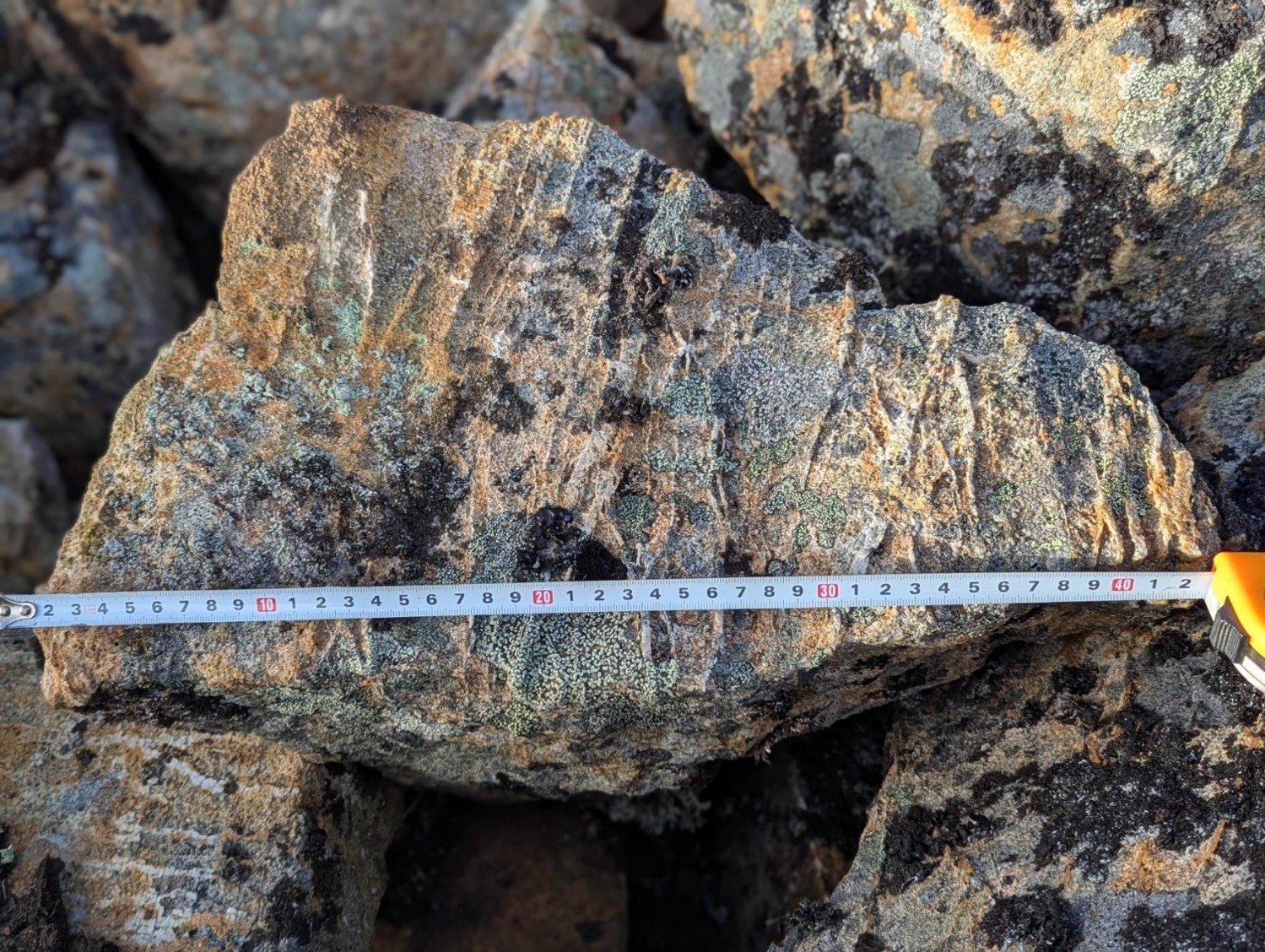
Figure 3 - Sheeted veining in a biotite granodiorite at Liam
Lois
The Lois project is underlain by variably hornfelsed Hyland Group siliciclastic rocks, which are intruded by a 3 km by 3 km mid-Cretaceous pluton in the eastern part of the property. Two soil geochemical anomalies on the property are defined by strongly elevated and coincident gold, copper, bismuth, arsenic and antimony in soil, with peak gold-in-soil values of 873 ppb. Calcareous members of Hyland Group, in proximity to the pluton, have been altered to skarn assemblage minerals, including areas of massive pyrrhotite, pyrite, arsenopyrite and chalcopyrite, where chip sampling has returned values of 1.57 g/t gold over 4.5 m.
In 2026, work at Lois, supported by a Yukon Mineral Exploration Program (YMEP) incentive grant, successfully identified several new areas of skarn mineralization, which are regularly up to two metres wide, along with areas of abundant quartz-tourmaline±arsenopyrite breccia. The variations of mineralization and geochemical signatures at Lois suggest a multi-phased mineralization history associated with the pluton.
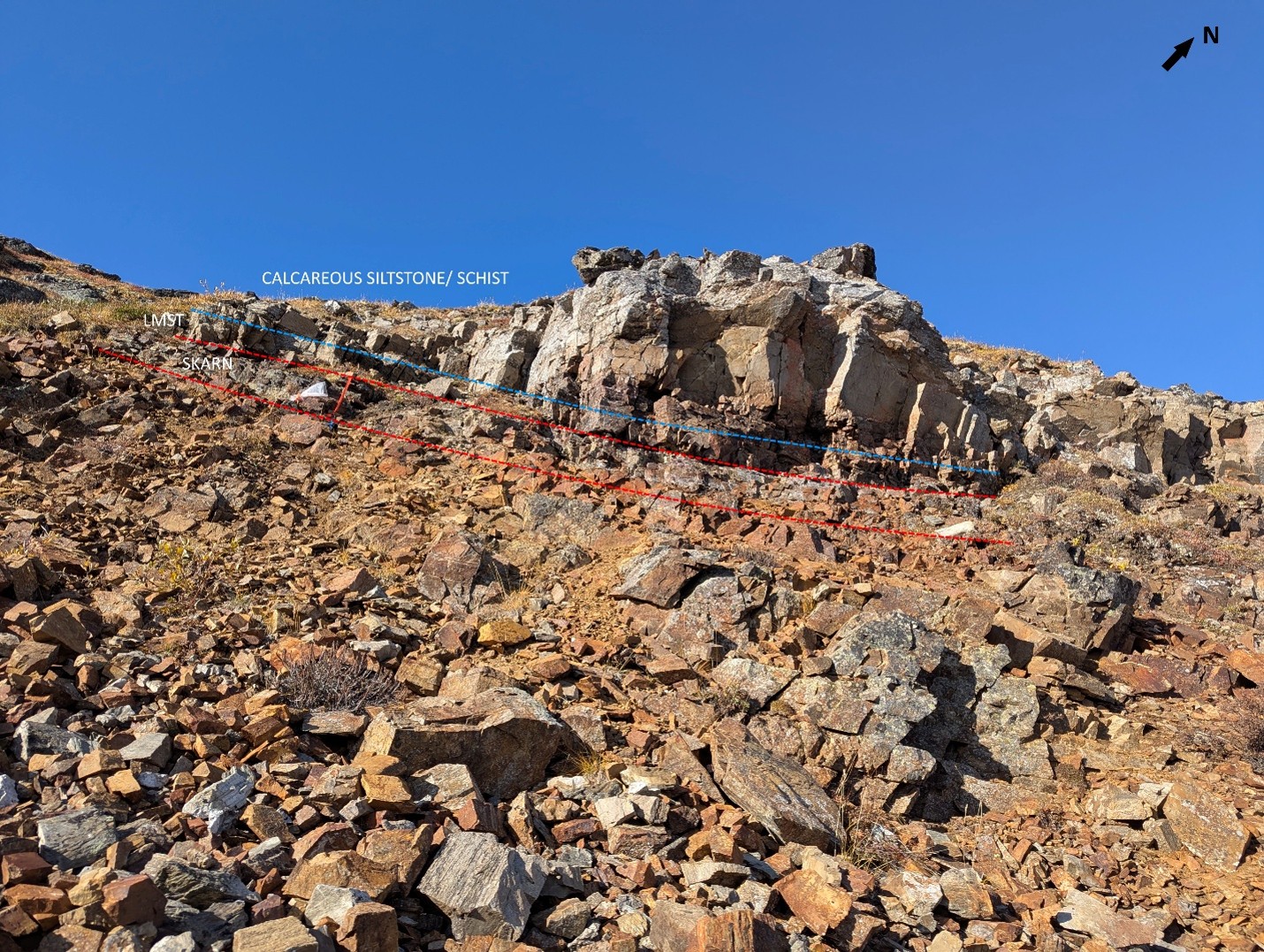
Figure 4 - A two-metre-wide skarn horizon, hosting semi-massive pyrrhotite-arsenopyrite-chalcopyrite, at Lois
Analytical results from the Liam and Lois projects will be announced once received and interpreted.
Upcoming Events
Trifecta Gold management will be attending and/or presenting at the following events:
- Precious Metals Summit - Beaver Creek, CO: September 22-25, 2026
- TAKESTOCK Investor Series - Calgary, AB: November 4, 2026
- Yukon Geoscience Forum - Whitehorse, YK: November 16-19, 2026
Quality Assurance / Quality Control (QAQC)
Technical information in this news release has been approved by Trifecta's Vice President, Jackson Morton, P.Geo., a qualified person as defined under the terms of National Instrument 43-101.
Tombstone Gold Belt
Extending more than 1000 km from the Fairbanks district in Alaska eastward across the entire width of Yukon, the Tombstone Gold Belt hosts many large Reduced Intrusion-Related Gold System (RIRGS) mines such as Fort Knox in Alaska (>10 million oz), Eagle and Olive in Yukon (>4 million oz) and the past-producing Brewery Creek Mine, also in Yukon. Since May 2020 over 20 million additional ounces of gold have been discovered in the Yukon portion of the belt, including Snowline Gold's Tier 1 Valley discovery, Sitka Gold's RC deposit, Banyan Gold's AurMac deposits and Victoria Gold's Raven deposit.
Tombstone Gold Belt systems are characterized by sheeted, auriferous quartz veins forming in the carapace zones of Cretaceous-age plutons. They have a characteristic geochemical signature with a gold-bismuth-tellurium±tungsten core within a broader gold-arsenic halo. The deposits are found within and surrounding the reduced intrusions and typically exhibit a geophysical signature comprising a magnetic low (ie. reduced) coinciding with a conductivity low. Veining in RIRGS is typically zoned with a core of sheeted veins surrounded by more discrete gold-arsenic veins and more distal silver-lead-zinc veins.
About Trifecta Gold Ltd.
Trifecta is a Canadian-based precious metals exploration company dedicated to increasing shareholder value through the discovery and development of 100% held gold projects in mining friendly jurisdictions. Trifecta has secured an option to acquire a 100% interest in Mt. Hinton, Rye and 9 other highly prospective, intrusion-related gold projects located in Yukon's Tombstone Gold Belt where over 20 million ounces of gold have been discovered since May 2020. The Company's Eureka Project hosts an 8 x 2.5 kilometre belt of surface showings and anomalous gold-in-soil that straddle the headwaters of two of the most productive placer creeks in Yukon's southern Klondike Goldfields. Trifecta's Treble Project covers a large hydrothermal system, located midway between Western Copper and Gold Corporation's Casino Deposit, the largest copper and gold deposit in the Yukon, and Rockhaven Resources Ltd.'s Klaza Deposit, a high-grade gold-silver deposit.
ON BEHALF OF THE BOARD
"Richard Drechsler"
President and CEO
For further information concerning Trifecta or its various exploration projects please visit www.trifectagold.com or contact:
Corporate Information
Trifecta Gold Ltd.
Richard Drechsler
President and CEO
Tel: (604) 687-2522
This news release may contain forward looking statements based on assumptions and judgments of management regarding future events or results that may prove to be inaccurate as a result of exploration and other risk factors beyond its control, and actual results may differ materially from the expected results.
Neither the TSX Venture Exchange nor its Regulation Services Provider (as that term is defined in the policies of the TSX Venture Exchange) accepts responsibility for the adequacy or accuracy of this news release.
SOURCE: Trifecta Gold Ltd.
View the original press release on ACCESS Newswire